The best visual science learning toys make ideas easier to see, whether a child is mixing colors, sorting rocks, exploring magnets, or viewing a specimen under magnification. I’d choose the Learning Resources Primary Science Lab Set as the best overall for its broad, hands-on experiment play; the TOMLOV DM301K Microscope Kit stands out for close-up investigation, while Learning Resources Primary Science Color Mixing Glasses offer a simpler entry point to visible cause and effect. The main tradeoff is between open-ended tools that support repeated experiments and focused activities that are easier for younger learners to start. Age fit, supervision, and how much setup a family wants also matter. Read on for the full breakdown and help matching a toy to the kind of science your child wants to see.

Prime made for students and young adults
- Fast, free delivery for dorm and study essentials
- Prime Video and Amazon Music included
- Member-only deals
Key Takeaways
- The Primary Science Lab Set is the broadest starting point: its experiment-oriented format gives it more range than a single-concept sorter or sensory toy.
- The microscope is the pick for magnified observation, not quick group play: it brings a distinct close-up view but asks for more setup and adult help than color glasses or sorting activities.
- Simple visual cause and effect can be a better first step: Color Mixing Glasses and Sensory Tubes make changes easy to observe without requiring a complex experiment.
- Several options teach through sorting and matching rather than lab work: the gem, life-cycle, and fine-motor sets suit children who learn by arranging and comparing objects.
- There is no single best toy for every science interest: magnets, seasonal changes, pixel patterns, magnification, and life cycles each call for different kinds of visual engagement.
| Learning Resources Primary Science Sensory Tubes |  | Best for Open-Ended Sensory Exploration | Brand: Learning Resources | Model number: LER2445 | Set contents: 4 clear tubes and 8 lids | VIEW LATEST PRICE | See Our Full Breakdown |
| Learning Resources Primary Science Color Mixing Glasses |  | Best for Learning Color Through Observation | Brand: Learning Resources | Model number: LER2446 | Age range: 3 years and up | VIEW LATEST PRICE | See Our Full Breakdown |
| Learning Resources Rock ‘n Gem Surprise Sorting and Matching Toy |  | Best for Discovery and Sorting Play | Brand: Learning Resources | Model number: LER2875 | Recommended age: 36 months–15 years | VIEW LATEST PRICE | See Our Full Breakdown |
| Learning Resources Primary Science Lab Set |  | Best Overall for Guided Visual Science Play | Brand: Learning Resources | Recommended age: 3 years and up | Set size: 22 pieces | VIEW LATEST PRICE | See Our Full Breakdown |
| Learning Resources Pixel Art Challenge – The Original STEM Pixel Art |  | Best for Visual Pattern and Spatial Reasoning | Brand: Learning Resources | Model number: LER9463 | Age range: 5–8 years | VIEW LATEST PRICE | See Our Full Breakdown |
| JoyCat Life Cycle Learning Toy Set |  | Best for Life-Cycle Learning | Brand: JoyCat | Model number: SMZQ001 | Animals covered: Butterfly, frog, ladybug, and bee | VIEW LATEST PRICE | See Our Full Breakdown |
| TOMLOV DM301K Microscope Kit for Kids and Students, 63 Pieces |  | Best for Beginner Microscopy | Model: DM301K | Brand: TOMLOV | Recommended age: 6–12 years | VIEW LATEST PRICE | See Our Full Breakdown |
| hand2mind Changing Seasons Sensory Tubes, Set of 4 |  | Best for Calm Seasonal Observation | Brand: hand2mind | Set contents: 4 sensory tubes and a Getting Started Guide | Seasons: Winter, spring, summer, and autumn | VIEW LATEST PRICE | See Our Full Breakdown |
| Teacher Created Resources Up-Close Science Magnifying Glasses and Tweezers Activity Set |  | Best for Shared Beginner Exploration | Brand: Teacher Created Resources | Model: TCR20368 | Age range: 3+ | VIEW LATEST PRICE | See Our Full Breakdown |
| Learning Resources Silly Science Fine Motor Sorting Set |  | Best for Preschool Sorting and Patterns | Brand: Learning Resources | Age range: 36 months–5 years | Educational objective: STEM | VIEW LATEST PRICE | See Our Full Breakdown |
| Learning Resources STEM Explorers Magnet Movers |  | Best for Exploring Invisible Forces | Brand: Learning Resources | Age range: 5–9 years | Piece count: Description states 39 pieces; unit count states 34 | VIEW LATEST PRICE | See Our Full Breakdown |
| visual science learning toy | Brand | Model number | Age range | Included components |
|---|---|---|---|---|
| Learning Resources Primary Sci | Learning Resources | LER2445 | — | — |
| Learning Resources Primary Sci | Learning Resources | LER2446 | 3 years and up | Glasses and color mixing chart |
| Learning Resources Rock ‘n Gem | Learning Resources | LER2875 | — | Counter toys |
| Learning Resources Primary Sci | Learning Resources | — | — | — |
| Learning Resources Pixel Art C | Learning Resources | LER9463 | 5–8 years | 400 foam pixel pieces, 5.5 × 5.5 inch tray, and challenge booklet |
| JoyCat Life Cycle Learning Toy | JoyCat | SMZQ001 | — | 21 insect introduction cards, double-sided wooden board, storage box |
| TOMLOV DM301K Microscope Kit f | TOMLOV | — | — | — |
| hand2mind Changing Seasons Sen | hand2mind | 95385 | 36 months–12 years | — |
| Teacher Created Resources Up-C | Teacher Created Resources | — | 3+ | — |
| Learning Resources Silly Scien | Learning Resources | LER5542 | 36 months–5 years | Clamp, tweezers, test tubes with lids and stand, plastic germs, matching cards |
| Learning Resources STEM Explor | Learning Resources | LER9295 | 5–9 years | Magnetic wand, magnets, rings, balls, chips, and activity cards |
More Details on Our Top Picks
Learning Resources Primary Science Sensory Tubes
For young children who learn by filling, pouring, and watching materials move, these four clear tubes offer a flexible starting point for visual science play. The interchangeable solid and vented lids let adults vary what children can see and handle, from liquid observations to dry materials and scents. Unlike the Learning Resources Primary Science Color Mixing Glasses, which focus on a specific lesson about color, these tubes invite families to change the subject whenever they change the contents. That flexibility is also the tradeoff: filling materials are not included, so an adult needs to gather supplies, prepare the tubes, and open them for refills. I’d choose them for repeated, adult-supported exploration rather than a ready-to-go experiment or a kit with guided activities.
Pros:- Four clear tubes make contents and changes visible during exploration
- Solid and vented lids support different materials and sensory activities
- Refillable design makes it easy to change themes over time
- Supports fine motor practice alongside early STEM exploration
Cons:- No materials for filling the tubes are included
- Adults need to open and refill the tubes
Best for: Caregivers and early-years educators who want refillable sensory activities for toddlers and preschoolers using materials they already have
Not ideal for: Buyers seeking a self-contained science kit with included materials or children who need to refill and manage the activity independently
- Brand:Learning Resources
- Model number:LER2445
- Set contents:4 clear tubes and 8 lids
- Lid types:4 solid and 4 vented
- Material:Clear plastic
- Recommended age:24 months–12 years
- Educational objective:Motor skills
Our verdict“Choose these tubes for flexible, adult-prepared sensory investigations, but pick the Primary Science Lab Set if you want tools and activity cards for guided experiments.”
Learning Resources Primary Science Color Mixing Glasses
These glasses turn color mixing into an immediate visual exercise: children look through individual lenses, combine colors, and compare what they see with the included mixing chart. That makes the science concept more direct than the Learning Resources Primary Science Sensory Tubes, whose learning depends on what an adult places inside. The interchangeable color and distortion lenses add variety, but the main value is helping children connect primary colors with the new colors that appear when filters overlap. There’s no battery or digital element, and the wipe-clean plastic lenses suit repeated handling. The tradeoff is a narrower learning focus: this is an observation aid, not a broader experiment kit like the Primary Science Lab Set. It also suits children ages 3 and up, rather than toddlers.
Pros:- Makes color combinations visible as children look through the lenses
- Interchangeable lenses allow individual and combined viewing
- Mixing chart gives children a visual reference for exploration
- Wipe-clean lenses and manual operation suit repeated classroom use
Cons:- Focuses mainly on color observation rather than a range of science concepts
- Not designed for children younger than 3
Best for: Preschool and early elementary caregivers or teachers who want a simple, visual activity focused on primary and secondary colors
Not ideal for: Families seeking a broad science kit, an activity for children under 3, or an experiment that produces results beyond viewing through colored lenses
- Brand:Learning Resources
- Model number:LER2446
- Age range:3 years and up
- Included lenses:2 red, 2 yellow, 2 blue, and 2 distortion lenses
- Included components:Glasses and color mixing chart
- Material:Metal and plastic
- Item dimensions:10.6 × 6.5 × 1.8 inches
- Power source:Manual; no batteries required
Our verdict“Pick these glasses for a focused, hands-on color lesson; choose the Primary Science Lab Set for more varied experiments and tools.”
Learning Resources Rock ‘n Gem Surprise Sorting and Matching Toy
The central appeal here is the reveal: children use a hammer and chisel to open reusable geodes, then inspect the colorful gems and sort, match, or count them. That sequence gives the activity a more discovery-led feel than the Learning Resources Primary Science Color Mixing Glasses, which guide attention toward a specific visual concept from the start. The gems also support shape recognition and early math, so the set can shift from a surprise activity into a sorting task. Compared with the Primary Science Lab Set, though, it offers less variety in the kinds of science investigations children can perform. The reported components are described only as counter toys, and no manufacturer warranty is listed. I’d favor it for children drawn to collecting and categorizing, with adult supervision for the cracking tools.
Pros:- Reusable geodes create a hands-on reveal before sorting begins
- Gems can be matched, sorted, and counted for repeat play
- Supports fine motor skills and hand-eye coordination
- Storage bag helps keep the pieces together between sessions
Cons:- Includes small gems and tools that call for adult supervision
- Component details identify the included items only as counter toys
- No manufacturer warranty is listed
Best for: Adults choosing a geology-themed discovery activity for children who enjoy opening surprises, sorting objects, and counting collections
Not ideal for: Buyers looking for guided experiments, a wide range of lab tools, or an activity without small pieces and cracking implements
- Brand:Learning Resources
- Model number:LER2875
- Recommended age:36 months–15 years
- Colors:8
- Shapes:4
- Included components:Counter toys
- Play activities:Crack reusable geodes, sort, match, and count
Our verdict“Choose this set for discovery-led gem sorting, while the Primary Science Lab Set is a better fit for children who want varied experiments.”
Learning Resources Primary Science Lab Set
This is the broadest hands-on science option in this group: a 22-piece tool set pairs familiar lab equipment with 10 double-sided activity cards about mixing, floating, and observation. Children can use a beaker, magnifying glass, funnel, eyedropper, and other tools to see what happens to common materials, giving the play more investigative structure than the Learning Resources Primary Science Sensory Tubes. It also covers more kinds of activity than the color-focused Primary Science Color Mixing Glasses. That range earns it my top spot for buyers seeking visual science learning with a clear starting point. The tradeoff is that household ingredients are not included, so caregivers still need to prepare experiments. Product details also report differing item counts, which may make the exact contents less clear before purchase.
Pros:- Broad range of tools supports different kinds of visual investigation
- Activity cards give adults and children experiment starting points
- Tools are sized for small hands
- Thick plastic construction is suited to repeated handling
Cons:- Experiments require common household ingredients that are not included
- Reported item counts differ between product details and the manufacturer description
Best for: Families, preschool teachers, and homeschoolers who want small-hand-sized tools and prompts for several beginner science investigations
Not ideal for: Buyers who want a complete kit without extra household supplies, or who need certainty about every piece included before purchase
- Brand:Learning Resources
- Recommended age:3 years and up
- Set size:22 pieces
- Included tools:Beaker, flask, magnifying glass, funnel, eyedropper, tweezers, safety goggles, test tubes with lids, and stands
- Activity cards:10 double-sided cards
- Material:Thick plastic
- Educational focus:STEM and early science investigations
Our verdict“Choose the Lab Set for the widest range of guided visual investigations, provided you are comfortable supplying household experiment materials.”
Learning Resources Pixel Art Challenge – The Original STEM Pixel Art
This set treats visual learning as a pattern-building challenge rather than a physical science experiment. Children arrange 400 foam pixels on a compact tray to make designs, using 40 screen-free challenges to practice spatial reasoning, problem-solving, and introductory coding ideas. That makes it a distinct choice beside the Primary Science Lab Set: the Lab Set explores materials and observations, while Pixel Art asks children to interpret and construct visual patterns. The hands-on format also builds fine motor control without screens. Its limitation for this roundup is that the science connection is less direct; it is strongest as a STEM activity centered on math and logic. The small pieces can be lost, and the 5–8 age range may not hold older children’s interest.
Pros:- Forty challenges provide structured visual problem-solving prompts
- Four hundred pieces support varied designs and pattern practice
- Screen-free play develops spatial reasoning and fine motor skills
- Compact tray works for classroom, homeschool, or independent activities
Cons:- Small foam pixels can be lost during play
- Foam pieces may collect dirt with frequent handling
- Age range may limit appeal for older children
Best for: Caregivers and educators seeking a screen-free pattern and coding-concept activity for children ages 5–8
Not ideal for: Buyers seeking experiments about nature, materials, or physical science, or families whose children are likely to lose small pieces
- Brand:Learning Resources
- Model number:LER9463
- Age range:5–8 years
- Included components:400 foam pixel pieces, 5.5 × 5.5 inch tray, and challenge booklet
- Challenge count:40
- Set name:STEM Explorers Pixel Art Challenge
- Item type:STEM Explorers Pixel Art Challenge
Our verdict“Choose Pixel Art for screen-free pattern, spatial, and coding-concept practice, not as a substitute for hands-on physical science experiments.”
JoyCat Life Cycle Learning Toy Set
I’d choose the JoyCat Life Cycle Learning Toy Set when a child learns best by arranging and comparing visible stages of animal development. Its figures, 21 introduction cards, and double-sided wooden board cover butterflies, frogs, ladybugs, and bees, giving a preschool lesson more structure than the open-ended observing offered by the Teacher Created Resources magnifying-glass set. The storage box also helps keep the pieces together for classroom or homeschool use. The tradeoff is that this is a focused life-cycle activity, not a general experiment kit: children looking to inspect real objects may get more from the TOMLOV microscope. Product information also lists 17 items while separately naming 21 cards and other components, so I can’t confirm the total piece count from the supplied details.
Pros:- Covers four animal life cycles with figures and learning cards.
- Double-sided wooden board gives activities a clear visual structure.
- Storage box supports tidier classroom or home storage.
- Designed for preschool, classroom, and homeschool activities.
Cons:- The stated count of 17 items conflicts with the separately listed 21 cards and other components.
- The focused life-cycle theme offers less variety than a microscope or general observation kit.
Best for: Preschool teachers and homeschool families seeking a visual, hands-on way to teach several animal life cycles.
Not ideal for: Families seeking a broad science kit or hands-on observation of real specimens; this set focuses on animal life-cycle models and cards.
- Brand:JoyCat
- Model number:SMZQ001
- Animals covered:Butterfly, frog, ladybug, and bee
- Included components:21 insect introduction cards, double-sided wooden board, storage box
- Listed number of items:17
- Materials:PVC and wood
- Recommended age:36 months to 8 years
- Educational objectives:Observation skills, curiosity, creativity, imagination, and learning ability
Our verdict“Choose JoyCat for guided visual lessons on four animal life cycles, but skip it if you want open-ended experiments or a clearly specified piece count.”
TOMLOV DM301K Microscope Kit for Kids and Students, 63 Pieces
The TOMLOV DM301K is the strongest pick here for children ready to examine small details rather than sort or match larger pieces. It combines a focus dial, dual LED lights, 12 prepared slides, and a phone adapter, so beginners have a starting point for viewing and sharing observations. Its rechargeable cordless design also makes it easier to move between a desk and a classroom than a fixed tabletop activity. Compared with the Teacher Created Resources magnifying glasses, it offers microscope-style viewing but asks more of the child: focusing and preparing a viewing setup take patience. The slides are plastic, and the supplied details don’t specify charging time. I’d pick the magnifying-glass set for simpler, shared exploration by younger children, and this kit for ages 6–12 ready for a more focused visual science activity.
Pros:- Dual LED lights support viewing prepared slides and solid objects.
- Focus dial is intended to help beginners adjust the image.
- Rechargeable cordless design supports flexible placement.
- Phone adapter allows users to share microscope views on a smartphone.
Cons:- The prepared slides are plastic.
- Charging time is not specified in the supplied product details.
- Microscope focusing may be less straightforward for young or impatient users than magnifying-glass exploration.
Best for: Families or teachers seeking a portable beginner microscope kit for children ages 6–12 who are ready to inspect slides and everyday objects.
Not ideal for: Preschoolers or adults seeking a quick, low-setup group activity; focusing through a microscope can require more patience than using magnifying glasses.
- Model:DM301K
- Brand:TOMLOV
- Recommended age:6–12 years
- Magnification:640x
- Lighting:Dual LED lights
- Power:Rechargeable battery
- Battery runtime:Up to 24 hours
- Included slides and accessories:12 prepared plastic slides and a phone adapter
- Kit size:63 pieces
Our verdict“Choose the TOMLOV for school-age beginners who want microscope views and phone sharing, rather than a simpler magnifier-based activity.”
hand2mind Changing Seasons Sensory Tubes, Set of 4
I’d place the hand2mind Changing Seasons Sensory Tubes in a different lane from the lineup’s experiment tools: they turn seasonal changes into a quiet, hands-on prompt for noticing and talking. Four color-coded tubes represent winter, spring, summer, and autumn, and the guide supplies activities for extending that observation. That makes this set a better fit for a calm corner or travel than the more tool-heavy TOMLOV microscope, which supports closer examination but calls for more setup. The tradeoff is narrow subject matter: these tubes focus on seasons rather than offering broad science activities, specimen viewing, or sorting challenges like the Learning Resources Silly Science set. They suit children who benefit from tactile, low-noise exploration, but buyers wanting visible magnification or a wider range of experiments should choose another option.
Pros:- Represents all four seasons in a hands-on format.
- Includes a guide with activities to prompt observation.
- Quiet format suits calm corners and travel.
- Designed for small hands and repeated use.
Cons:- The activity range is focused on seasonal themes rather than broader science topics.
- Intended for children ages 3 and older, so it is not suitable for children under 3.
Best for: Caregivers and educators seeking a quiet, portable activity for discussing seasonal patterns with children ages 3 and up.
Not ideal for: Buyers seeking microscope-style detail, experiments, or a wide range of science topics; the four tubes center on seasons.
- Brand:hand2mind
- Set contents:4 sensory tubes and a Getting Started Guide
- Seasons:Winter, spring, summer, and autumn
- Age range:36 months–12 years
- Model number:95385
- Manufacturer part number:95385
- UPC:848850119554
Our verdict“Choose these tubes for quiet, seasonal observation and conversation, not for magnification or varied science experiments.”
Teacher Created Resources Up-Close Science Magnifying Glasses and Tweezers Activity Set
The Teacher Created Resources Up-Close Science Set makes visual science feel approachable: four 3X magnifying glasses let children inspect nearby objects, while tweezers encourage careful handling. Five double-sided activity cards add a starting point, so this is more guided than simply handing children a lens. Compared with the TOMLOV microscope, the magnifiers are easier to share and require less focusing; the microscope is the better choice for examining prepared slides at higher magnification. This set also brings four tool pairs into one activity, making it well suited to small groups. Its limitation is that the cards rely on household or classroom materials that aren’t included, so adults may need to gather supplies before an activity. I’d favor it for preschool exploration, not for children ready for detailed microscope viewing.
Pros:- Four magnifying glasses and four tweezers support group exploration.
- Activity cards introduce observation and basic science concepts.
- 3X magnification offers an accessible way to inspect nearby objects.
- Storage stand gives the tools a designated home.
Cons:- Activity cards rely on household or classroom materials that are not included.
- 3X magnification cannot match the close-up viewing available from the TOMLOV microscope.
Best for: Preschool classrooms, playgroups, and families seeking a shared, low-complexity introduction to observation and simple science activities.
Not ideal for: Older children seeking high-magnification viewing or buyers who want experiments fully supplied; the activity cards require additional materials.
- Brand:Teacher Created Resources
- Model:TCR20368
- Age range:3+
- Magnifying glasses:4; 6-3/4 in. long with 3 in. diameter lenses
- Magnification:3X
- Tweezers:4; 4-3/4 in. long x 1-5/8 in. wide
- Activity cards:5 double-sided
- Storage stand:Assembled size: approximately 8 x 2-3/4 x 4-3/4 in.
- Item weight:0.41 kg
Our verdict“Choose this set for shared preschool observation with simple tools, and choose the TOMLOV instead when detailed slide viewing matters more.”
Learning Resources Silly Science Fine Motor Sorting Set
The Learning Resources Silly Science Fine Motor Sorting Set treats science as a hands-on way to practice sorting, matching, counting, and pattern building. Colorful germ-shaped pieces make categories easy for preschoolers to see, while tweezers and a squeeze clamp turn each task into fine-motor practice. Game cards give the play structure, which distinguishes this set from the more open-ended Teacher Created Resources magnifiers; those are better for looking closely at real objects, while this one is built around arranging and comparing pieces. It is a focused early-learning activity, not a substitute for observing natural specimens or using a microscope. The stated age range ends at five, and the small components call for supervision, especially around younger children. I’d choose it for preschoolers learning patterns and counting, not for school-age children seeking deeper science investigation.
Pros:- Combines sorting, color matching, pattern building, and counting.
- Tweezers and a squeeze clamp give children fine-motor practice.
- Game cards provide structure for guided play.
- Colorful germ-shaped pieces make sorting categories easy to see.
Cons:- The stated age range is limited to 36 months–5 years.
- Small components may require adult supervision.
Best for: Preschool families and educators looking to combine visible sorting, pattern building, counting, and tool-based motor practice.
Not ideal for: School-age children seeking specimen observation or extended science investigations; the activities target ages 3–5 and use small components.
- Brand:Learning Resources
- Age range:36 months–5 years
- Educational objective:STEM
- Included components:Clamp, tweezers, test tubes with lids and stand, plastic germs, matching cards
- Model number:LER5542
- Number of items:1
- UPC:765023055429
Our verdict“Choose this set for preschool sorting and fine-motor play, but pick magnifiers or a microscope for direct observation of real objects.”
Learning Resources STEM Explorers Magnet Movers
I’d choose Magnet Movers for children who learn best by seeing an effect and then testing what caused it. Its wand, magnets, rings, balls, and chips let kids explore attraction, repulsion, and motion, while 10 guided challenges give the activity more direction than open-ended play alone. Compared with the Learning Resources Primary Science Color Mixing Glasses, which makes color changes visible, this set focuses on forces that can be hard to see directly; moving objects make the magnetic effect easier to observe. The tradeoff is that its visual payoff depends on arranging and watching the pieces, rather than looking through a microscope or at a vivid color change. Product information also conflicts on the piece count: the description says 39, while the unit count says 34. I’d treat the count as uncertain when comparing sets.
Pros:- Lets children observe attraction, repulsion, and motion through hands-on experiments
- Includes 10 guided challenges alongside opportunities for open-ended exploration
- Varied magnetic pieces support comparing how different objects respond
- Designed for home or classroom use
Cons:- Product information conflicts on whether the set contains 39 or 34 pieces
- No manufacturer warranty is listed
- Visual learning depends on watching objects move rather than using magnification or color-based demonstrations
Best for: Parents and teachers seeking guided, hands-on magnetism activities for children ages 5–9, especially for small-group exploration at home or in a classroom.
Not ideal for: Buyers who want a highly visual microscope experience, a clearly stated piece count, or a set backed by a manufacturer warranty.
- Brand:Learning Resources
- Age range:5–9 years
- Piece count:Description states 39 pieces; unit count states 34
- Guided activities:10 challenges
- Included components:Magnetic wand, magnets, rings, balls, chips, and activity cards
- Model number:LER9295
- Warranty:No warranty
Our verdict“Choose Magnet Movers for guided, hands-on exploration of magnetic forces, but skip it if a consistent piece count or a more directly visual instrument is your priority.”
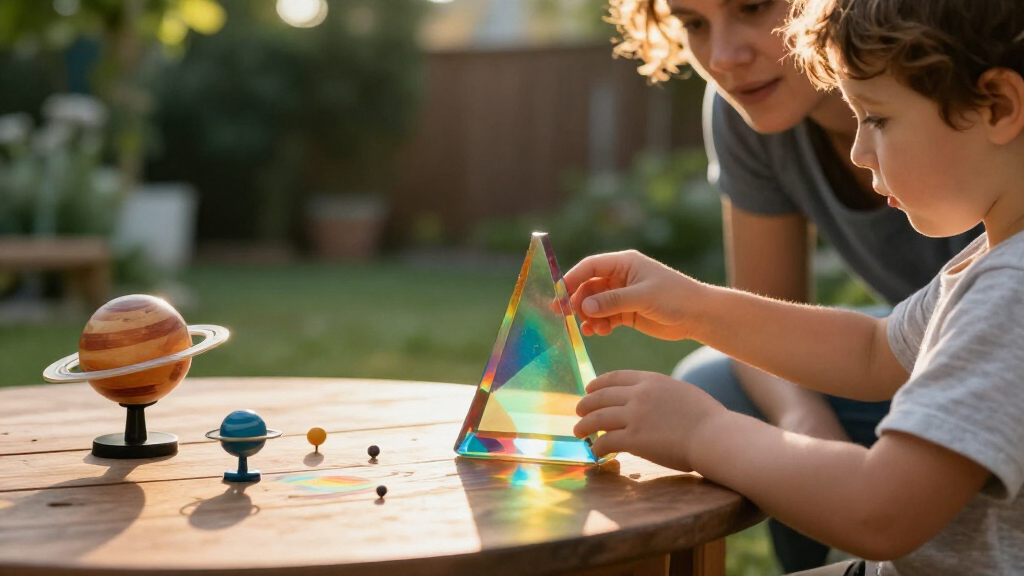
How We Picked
I ranked these visual science learning toys by how clearly each one connects a child’s actions to something observable. I looked at the visibility of the learning concept, the kind of interaction it invites, the likely age and supervision fit, and whether the activity can hold interest beyond a single demonstration. I also weighed practical differences such as setup, small parts, cleanup, and whether the toy offers a focused lesson or several ways to explore.
The Primary Science Lab Set ranks first because it offers the widest hands-on science starting point in this group. The microscope earns a distinct place for detailed observation, while the color glasses are especially approachable for a clear, immediate visual effect. Sorting and sensory products rank lower for broad experiment range, but they can be better matches for younger children or a specific interest. This ranking reflects fit and versatility, not a claim that one format is best for every child.
| visual science learning toy | Brand |
|---|---|
| Learning Resources Primary Sci | Learning Resources |
| Learning Resources Primary Sci | Learning Resources |
| Learning Resources Rock ‘n Gem | Learning Resources |
| Learning Resources Primary Sci | Learning Resources |
| Learning Resources Pixel Art C | Learning Resources |
| JoyCat Life Cycle Learning Toy | JoyCat |
| TOMLOV DM301K Microscope Kit f | TOMLOV |
| hand2mind Changing Seasons Sen | hand2mind |
| Teacher Created Resources Up-C | Teacher Created Resources |
| Learning Resources Silly Scien | Learning Resources |
| Learning Resources STEM Explor | Learning Resources |
Factors to Consider When Choosing Visual Science Learning Toys
Before choosing, I’d match the toy to the kind of visual learning your child enjoys: seeing a transformation, examining a tiny detail, or organizing objects into patterns. These broader checks can help avoid a common mismatch, such as buying a detailed kit when a child wants a quick activity or choosing a simple sorter when they are ready to run experiments.
Choose the Kind of Visual Discovery
Visual science toys do not all teach in the same way. Some show cause and effect, such as a change in color or movement; others reward careful observation, like a microscope or magnifier. Sorting and matching activities make relationships visible through grouping, sequencing, or comparison. Start by asking whether your child likes to change things, inspect them, or arrange them. A toy that fits that preference is more likely to invite repeat play than one chosen only because it has a science label. If your child enjoys more than one style, a broader kit may offer more lasting variety.
Match Complexity to Independence
A kit can be educational and still need close adult involvement. Look beyond the age label and think about how well your child handles instructions, small components, and multi-step activities. Younger children may get more from a simple, visible action than from a tool that requires careful setup. Older or patient children may enjoy a microscope or a structured challenge, especially when an adult can help with the first session. A common mistake is buying for the child’s future ability rather than the way they play today. If independent use matters, prioritize a clear activity and manageable pieces over a large assortment of tools.
Balance Range Against Focus
Broad kits can introduce several kinds of exploration, while focused toys often make one idea easier to understand. The larger assortment is not automatically the better choice: extra components may sit unused if the child has one strong interest. A focused product can be a smart pick when it directly matches that interest, such as close-up viewing or magnetic movement. On the other hand, families unsure what will capture a child’s attention may prefer a kit with varied activities. Think about whether you want one concept explored clearly or several pathways to discover what holds attention.
Check Setup, Storage, and Cleanup
Hands-on science often involves small pieces, arranging parts, or preparing materials, so the activity’s practical demands affect how often it gets used. Consider where the toy will be played with and whether components can be stored together between sessions. A quick visual activity may suit a busy routine better than a kit that needs adult preparation each time. For products involving loose parts, ask whether your household can keep them organized and out of reach of younger siblings. Easy repeat access can matter more than having the most elaborate set of components. Look at the activity format, not just the box contents, before deciding.
Think About What Counts as Science for Your Child
Some families picture science as experiments with tools, but visual learning can also come from observing life cycles, comparing natural objects, or recognizing patterns. A child who enjoys collecting and classifying may connect more with a sorting activity than with a lab-style set. A child drawn to images and design may find pattern challenges engaging even when the activity does not resemble a traditional experiment. Avoid assuming that more technical-looking equipment will produce more curiosity. Choose a concept your child can notice, discuss, and revisit in everyday life. That connection helps turn a short play session into ongoing questions.
Pay More for a Clear Reason
A premium or more involved toy makes sense when it adds a capability your child will use, such as closer observation or a wider range of experiments. It is less compelling if the added parts create complexity without changing the learning experience. Compare what the child will actually do with the toy, not just how many pieces are included. If a simple set already teaches the desired idea clearly, paying for a broader kit may not improve the fit. For a child with a strong, sustained interest, specialized equipment can be worthwhile; for a first science toy, ease of use and visible results may matter more than expansion potential.
Frequently Asked Questions
Which toy is the best first visual science toy for a young child?
I’d start with an activity that shows a clear result without requiring several steps. The Primary Science Color Mixing Glasses offer a direct visual effect, while the Sensory Tubes invite observation through changes and movement. The better fit depends on whether your child enjoys looking through a tool or handling and watching objects. Save more involved equipment for a child who can manage setup with adult support. Always check the product’s age guidance and supervise play when small parts are present.
Is a kids’ microscope kit worth choosing over a simple magnifier activity set?
A microscope kit makes more sense when a child is ready to spend time positioning and viewing specimens for fine detail. A magnifier-and-tweezers activity set is generally a more direct route to examining objects, with less emphasis on equipment setup. The microscope offers a different scale of observation, but that benefit depends on a child’s patience and adult availability. If the child wants quick exploration outdoors or around the home, a simpler magnifying activity may see more use. Choose the microscope for sustained close-up curiosity, not just because it appears more advanced.
Are sorting toys genuinely useful for teaching science?
They can support early scientific habits by asking children to notice similarities, differences, sequences, and categories. Those skills are useful foundations for observation, even when the toy does not involve a conventional experiment. The Rock ’n Gem set and Silly Science Fine Motor Sorting Set lean toward hands-on classification, while the Life Cycle Learning Toy Set adds sequencing as a visual task. They may be less satisfying for a child who wants to mix, build, or test a result. Look for a sorting toy that prompts conversation about why objects belong together, rather than focusing only on finishing the task.
How do I choose between a broad lab set and a toy focused on one science idea?
Choose a broad lab set when your child has varied interests or you want one toy to introduce several ways of experimenting. Pick a focused activity when a particular concept already holds their attention or when simplicity is a priority. A wide selection can offer variety, but it may also mean more pieces to manage and more adult help. A focused toy can make one idea easier to revisit and explain. Consider how your child plays now and whether they prefer to explore freely or work toward a clear activity.
What should I check before buying a visual science toy for siblings of different ages?
Check age guidance, small-part warnings, and whether older children can stay engaged while younger siblings need supervision. A shared toy can work well if the older child can take on more complex observation while the younger one handles a simpler matching or viewing task. Avoid assuming that a single kit will be equally suitable for both ages without adult adjustment. Storage also matters, since small components from science sets can be difficult to separate from toys meant for younger children. If ages differ widely, a simple shared activity plus a separate advanced tool may be a better arrangement.
Conclusion
For the widest range of hands-on science play, I recommend the Learning Resources Primary Science Lab Set as best overall. The best value in learning style is the Primary Science Color Mixing Glasses: they focus on a clear, approachable visual effect without requiring a broad kit. For a more involved, specialized option, choose the TOMLOV DM301K Microscope Kit as best premium for children drawn to close-up observation. Beginners may prefer the color glasses or Primary Science Sensory Tubes, while children who learn through organizing and sequencing may be better served by the Rock ’n Gem, Life Cycle, or Silly Science sorting sets. For a specific interest, choose Magnet Movers for magnetic action, Changing Seasons Sensory Tubes for visual observation, or Pixel Art Challenge for pattern-focused STEM play. Match the toy to the kind of discovery your child wants to repeat, and the right pick becomes much clearer.
Fall Picks
fall essentials
As an affiliate, we earn on qualifying purchases.