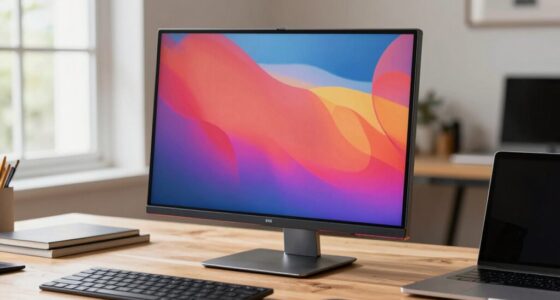
Choosing between a 4K and an ultrawide monitor depends on your main use. If you want sharp, detailed visuals for creative work or high precision, a 4K display is ideal. If you prefer a broader, immersive view for gaming or multitasking, an ultrawide monitor suits you better. Keep in mind, your hardware can impact performance and image quality. To find out how to match your setup perfectly, explore more details ahead.

Get school and study supplies delivered free — and shop member deals
- Fast, free delivery on millions of items
- Access to Prime Big Deal Days deals on October 6–7
- Prime Video, Amazon Music and more included
Key Takeaways
- Choose 4K for detailed visuals and precise editing, ideal for creative workflows requiring sharp image quality.
- Opt for ultrawide monitors to expand horizontal workspace, enhancing multitasking and immersive gaming experiences.
- Consider desk space; ultrawide monitors often require more room, while 4K monitors can be more space-efficient.
- Ensure your hardware supports high resolutions or wide aspect ratios to avoid performance issues.
- Match monitor choice to primary use: gaming and immersion favor ultrawide, creative work favors 4K clarity.
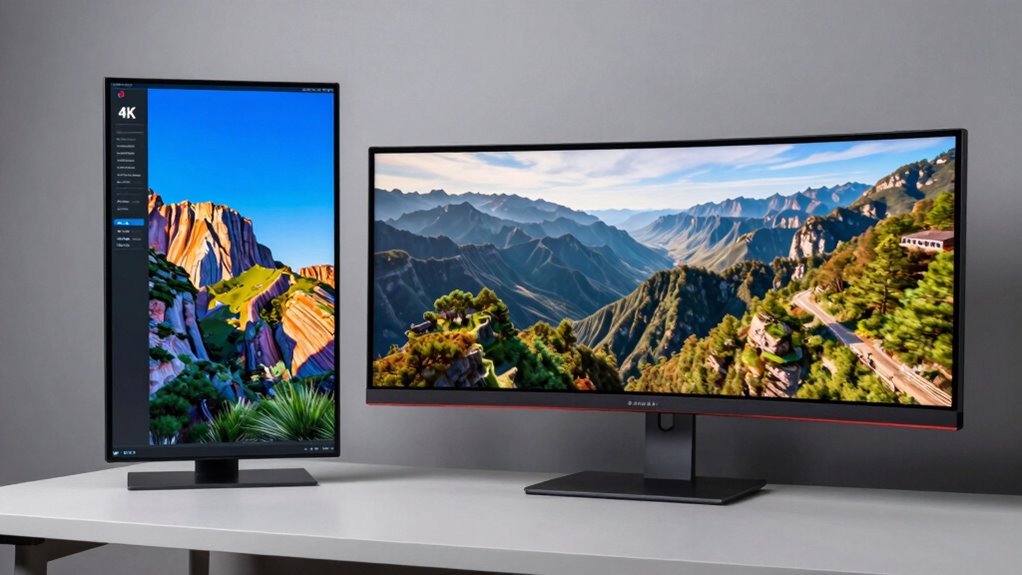
Are you trying to decide between a 4K monitor and an ultrawide display? Both options have their strengths, but the choice ultimately depends on what you prioritize most in your setup. If you’re into gaming, you’ll want to consider how each monitor type influences your gaming performance. A 4K monitor delivers crisp, detailed visuals, making games look stunning and immersive. However, the higher resolution can demand more from your graphics card, potentially leading to lower frame rates if your hardware isn’t top-tier. On the other hand, ultrawide monitors excel at providing a broader field of view, which can make your gaming experience more expansive and engaging, especially in titles that support wider aspect ratios. The stretch across a wider screen can give you an edge in competitive gaming, as you see more of the environment at once, but watch out for potential performance drops if the ultrawide’s resolution is very high.
When it comes to creative workflows, your choice might lean differently. A 4K monitor offers incredible detail and sharpness, making it ideal for tasks like photo editing, video production, and detailed design work. The high resolution allows you to see finer details and work with multiple windows side-by-side without feeling cramped. Its uniform aspect ratio simplifies compatibility with standard creative software, and many professionals prefer it for its accuracy and clarity. An ultrawide display, however, shines in workflows that benefit from increased horizontal space. If you’re editing long video timelines, working with complex spreadsheets, or multitasking across several applications, the extra width can boost your efficiency. It minimizes the need to switch between windows, streamlining your process. Yet, keep in mind that some creative tools may not fully support ultrawide resolutions, which could result in letterboxing or distorted interfaces. Additionally, understanding display technology can help you choose the best monitor for your specific needs.
Furthermore, considering hardware capabilities is crucial, as not all systems can effectively support the higher resolutions or wider aspect ratios without experiencing performance issues. Ultimately, your decision hinges on your specific needs. If gaming performance and immersive visuals are your top priorities, a high-quality ultrawide might be the best fit, especially if you value a more panoramic view. If precision, detail, and clarity for creative work matter more, a 4K monitor will serve you better. Consider your hardware capabilities, desk space, and the types of tasks you perform most often. Both monitors can elevate your experience, but understanding how each aligns with your workflow and gaming style will help you make the right choice.
4K computer monitor for creative work
As an affiliate, we earn on qualifying purchases.
As an affiliate, we earn on qualifying purchases.
Frequently Asked Questions
Do Ultrawide Monitors Support Multi-Monitor Productivity Setups?
Yes, ultrawide monitors support multi-monitor productivity setups, making it easier to multitask without bezels breaking your workflow. They often provide a seamless viewing experience, which enhances gaming compatibility and boosts productivity. However, consider your desk space, as ultrawides can be large and might require a wider setup. If space isn’t an issue, an ultrawide can replace multiple monitors, offering a clean, immersive, and efficient workspace.
Which Monitor Type Offers Better Color Accuracy for Creative Work?
If you need better color accuracy for creative work, go for a monitor with superior color calibration and a wide display gamut. Typically, professional-grade 4K monitors excel here, offering precise color reproduction essential for tasks like photo editing and graphic design. Ultrawide monitors may have good color, but they often prioritize screen real estate over exact color fidelity. So, choose a monitor with excellent color calibration and a broad display gamut for accurate results.
How Do Refresh Rates Compare Between 4K and Ultrawide Displays?
In a resolution comparison, ultrawide monitors often have lower refresh rates than 4K displays, which can impact gaming performance. Many ultrawide screens max out at 75Hz or 100Hz, while some 4K monitors reach 120Hz or higher. If smooth gameplay is your priority, a higher refresh rate on a 4K monitor gives you better performance. However, ultrawide screens still offer immersive visuals with decent refresh rates for most gaming needs.
Are Ultrawide Monitors More Prone to Distortion or Image Stretching?
Ultrawide monitors can sometimes cause distortion or image stretching, especially if the aspect ratio isn’t properly supported by your software or game. Screen curvature can help reduce this issue by ensuring a more consistent viewing experience, but it doesn’t eliminate potential distortion. To avoid this, choose a monitor with a well-supported aspect ratio and consider a curved display for a more natural, immersive look that minimizes stretching.
What Are the Typical Price Differences Between 4K and Ultrawide Monitors?
You’ll find that 4K monitors generally cost more than ultrawide monitors, especially for high-end models, but there are budget options for both. If you prioritize gaming enhancements like higher refresh rates, ultrawides often offer better value at lower prices. Conversely, if you want sharp detail and crisp visuals, 4K screens tend to be pricier. Consider your budget and gaming needs to choose the monitor that offers the best bang for your buck.
ultrawide gaming monitor 34 inch
As an affiliate, we earn on qualifying purchases.
As an affiliate, we earn on qualifying purchases.
Conclusion
Choosing between a 4K and ultrawide monitor depends on your needs. For example, a graphic designer might prefer a 4K for sharp detail, while a gamer or video editor could benefit from the immersive experience of ultrawide. Think about your workflow and space. Ultimately, the right setup enhances your productivity and enjoyment—so pick what aligns best with your tasks and desk space, and you’ll see the difference.
high resolution monitor for photo editing
As an affiliate, we earn on qualifying purchases.
As an affiliate, we earn on qualifying purchases.
ultrawide monitor for multitasking
As an affiliate, we earn on qualifying purchases.
As an affiliate, we earn on qualifying purchases.
Halloween Picks
halloween
As an affiliate, we earn on qualifying purchases.