
TL;DR

Prime made for students and young adults
- Fast, free delivery for dorm and study essentials
- Prime Video and Amazon Music included
- Member-only deals
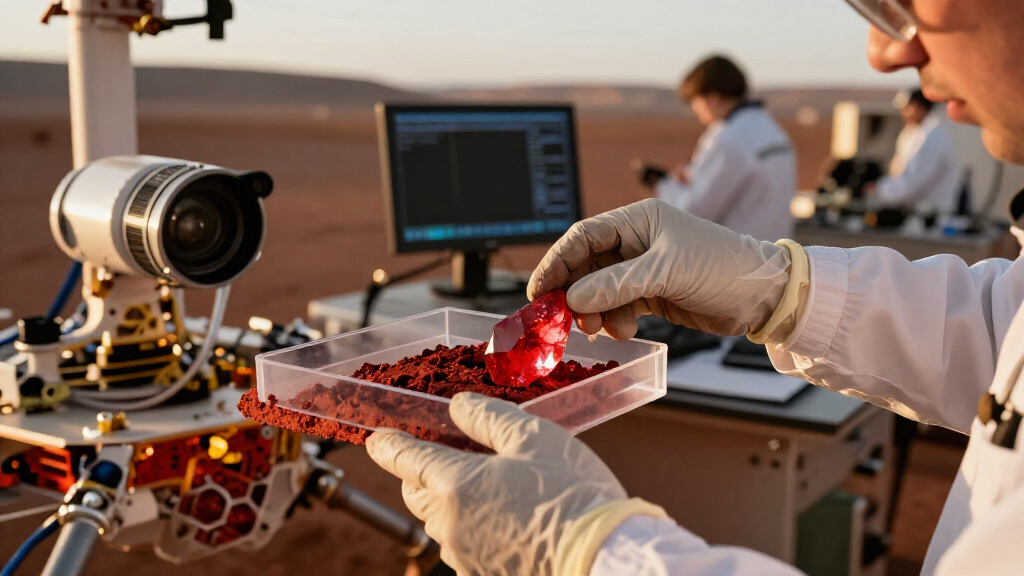
NASA’s Perseverance rover detected a narrow red luminescence signal from chromium-bearing corundum in a light-colored Martian rock. The mineral’s gemstone form is ruby, but NASA says the discovery is not a find of collectible rubies; the crystals may help researchers study ancient impact-related heating near Jezero crater.
NASA’s Perseverance rover has detected a red luminescence signal associated with chromium-bearing corundum in a light-colored rock on Mars, a finding that may help researchers investigate the planet’s ancient geological history. The gemstone form of chromium-containing corundum is ruby, but the rover has not found collectible rubies on Mars, according to a NASA account by SuperCam principal investigator Roger C. Wiens.
The signal was first noticed about two years before the Nov. 9, 2026, NASA article, when the rover’s SuperCam instrument fired its laser at a light-colored rock. The team observed narrow luminescence peaks at 692.7 and 694.1 nanometers. Wiens said the delayed light emissions are produced by chromium atoms in a corundum mineral structure.
SuperCam can measure the timing of the emitted photons, allowing researchers to connect the signal to chromium in corundum. The rover also carries PIXL and SHERLOC, instruments that can identify elements or minerals using methods including X-ray fluorescence, Raman spectroscopy and infrared spectroscopy. The research on the luminescence was published earlier in 2026 in Geophysical Research Letters by a team led by Ann Ollila, Wiens wrote.
NASA’s account says the team initially used the time-resolved luminescence technique only occasionally. It has more recently applied the observations frequently to light-toned rocks, looking for further evidence of impact effects. The article does not name a specific rock or provide a count of detections.
Clues to Jezero’s Impact History
The result matters less as a gemstone discovery than as a possible geological clue. Corundum is associated with metamorphic and pegmatitic settings, which Wiens says researchers would not expect to find readily on Mars because the planet lacks plate tectonics. Its presence could help scientists investigate how localized geological processes altered Martian rocks.
Wiens points to large meteor and asteroid impacts as one possible source of local metamorphism: heat from an impact can affect surrounding material over time. Perseverance is working in ancient terrain near the rim of Jezero crater, where the team expects evidence of localized metamorphism. The observations could therefore add information about the region’s past, although the NASA account presents impact heating as a geological explanation to investigate, not as a conclusively established cause of the corundum.
The detection also shows how an instrument designed to study rock chemistry can provide an additional kind of measurement. SuperCam’s time-resolved luminescence capability gives the team another way to examine selected rocks, alongside its other spectroscopy techniques. It expands what researchers can look for as Perseverance studies Mars’ rock record.
Products Worth Considering

Arlo Essential Wireless Security Camera 2K (3rd Gen) – 3-Cam Kit with Yard Sign

eufy Security SoloCam E42 4-Camera Kit, 4K Solar Security System

Philips Hue White and Color Ambiance Smart Retrofit Recessed LED Downlights, 5/6-Inch, 4-Pack
As an affiliate, we earn on qualifying purchases.
How SuperCam Spotted the Signal
Perseverance carries instruments built to investigate the composition and mineralogy of rocks. SuperCam’s Raman spectroscopy can also measure time-resolved luminescence, in which a material emits light after being excited by the instrument’s laser. In this case, the distinctive narrow peaks provided evidence of chromium in a corundum structure.
Wiens explains that the gemstone known as ruby is the chromium-containing form of corundum. Before SuperCam was installed on the rover, the team tested its laser on a ruby on Earth and saw a bright red glow. That laboratory demonstration helped illustrate the signal, but it does not mean that a gemstone-sized ruby was found on Mars: the rover’s observation concerns small corundum crystals in a rock.
The NASA post describes Perseverance as the first mission working in this kind of ancient terrain. Its observations are part of a broader effort to learn about the planet’s past from rocks preserved near Jezero crater. The post refers readers to the 2026 research paper for details of the luminescence results.
What the Mineral Signal Cannot Show
The NASA account does not specify the exact rock location, the abundance or size of the corundum crystals, or how many rocks have produced the signal. It also does not establish whether impact heating caused the mineral’s formation or alteration. That remains a possible interpretation based on the terrain and the known effects of large impacts.
The report does not describe the find as a ruby deposit or say that the crystals are large enough to collect. It identifies a luminescence signal consistent with chromium in corundum. The account also does not provide a complete summary of the paper’s methods, results or limitations, so those details should be checked against the Geophysical Research Letters study.
More Luminescence Surveys on Mars
Wiens says the team has recently been making time-resolved luminescence observations more frequently on light-toned rocks, seeking further evidence of impact effects. The next step described in the NASA account is continued analysis of those rover measurements as Perseverance explores ancient terrain near Jezero crater.
The article does not announce a date for a new paper, a planned release of additional measurements or a specific mission milestone tied to the search. Researchers’ conclusions about the mineral’s distribution and possible geological origin will depend on further observations and analysis.
Key Questions
Did Perseverance find actual rubies on Mars?
No gemstone-sized or collectible rubies were reported. The rover detected a signal associated with chromium-bearing corundum, whose gemstone form is ruby.
How did the rover identify the mineral?
SuperCam used its laser and time-resolved luminescence capability. The team measured narrow peaks at 692.7 and 694.1 nanometers and linked the delayed emissions to chromium in corundum.
Why are scientists interested in corundum on Mars?
Corundum can provide a clue to how rocks formed or changed. The team is investigating whether localized heating from ancient impacts could help explain its presence in terrain near Jezero crater.
Has an impact been confirmed as the cause?
No. NASA’s account presents impact-related heating as a possible explanation, not a confirmed cause. More observations and analysis are needed to determine the mineral’s geological history.
What happens next?
The SuperCam team says it is making more frequent luminescence observations of light-toned rocks to look for additional evidence of impact effects. NASA has not announced a date for a specific follow-up report.
Source: science.nasa.gov