
TL;DR

Prime made for students and young adults
- Fast, free delivery for dorm and study essentials
- Prime Video and Amazon Music included
- Member-only deals
Science-themed Halloween costumes work because they’re cheap, DIY-friendly, and clever — think a lab coat worn backward, apples pinned all over a shirt for ‘gravity,’ or a cat in a labeled box for Schrödinger. This guide covers individual, pun, group, and kids’ costume ideas plus safety basics like visibility and flammability, most buildable for under $20.
Apples safety-pinned all over a black shirt. That’s it. That’s the costume — you’re Gravity, and you’ll spend the whole party watching people’s faces change from confusion to delight.
Science-themed Halloween costumes have become one of the fastest-growing costume niches of the past few years, and it’s easy to see why. They appeal to educators, STEM professionals, students, and parents who want something smarter than a store-bought vampire. Plus, most of them cost pocket change.
In this guide, you’ll get quick last-minute ideas, step-by-step DIY builds, group and family themes, kid-safe options, and the safety details nobody thinks about until it’s too late.
A white button-down shirt worn backward is a near-perfect free lab coat substitute — the single best hack in this guide.
Pun costumes (Gravity, Static Cling, Schrödinger’s cat) cost under $20 and consistently outperform store-bought costumes at $40–$70.
Build a DNA double helix from two pool noodles plus balloon "base pairs" in about one hour, no sewing required.
For kids: skip full-face masks and small detachable parts — visibility and dress-code compliance matter more than costume detail.
Never use real chemicals, open flames near DIY fabric, or mains-powered lights; colored water and battery LEDs are safe stand-ins.
Why Science Costumes Win: Clever Beats Expensive Every Time
Science costumes are the rare costume category where being smart is the whole point. A $60 pre-packaged outfit gets a nod; a person dressed as Schrödinger’s cat gets a crowd. According to the National Retail Federation, the average person spends over $100 on Halloween — most science costumes undercut that dramatically.
Why does cleverness outperform cash here? Because a costume is really a social object, not a garment. Its job is to start conversations and signal something about who you are. A store-bought outfit says “I bought a costume”; a pun costume says “I had an idea.” That second message is what people respond to — the costume becomes a tiny puzzle the whole room gets to solve, and every “wait… I get it!” moment is a social win the wearer didn’t have to work for.
The tradeoff, to be honest, is effort in a different currency: pun costumes demand creativity and a few minutes of explanation to people outside your field. If your office party includes no one who’ll recognize Photo 51, a historical scientist costume reads as “fancy old-timey outfit” — cleverness only lands when the audience can decode it. Matching the idea to the room matters as much as the idea itself.
They also appeal to educators who want a costume that doubles as a conversation starter in class on November 1st. A teacher dressed as Marie Curie — black dress, glow-stick “radium” jar, radium-colored earrings — has a built-in history lesson. That’s a second payoff most costume categories simply can’t offer: the costume keeps generating value after the party ends.
And since 2020, microbe and virus costumes went from niche to mainstream, while AI and chatbot costumes have been rising sharply since 2023 — a sign that science costumes track whatever the culture is currently anxious or excited about, which is exactly why the category keeps refreshing itself. Science isn’t just for scientists anymore.
The best costume at the party is never the most expensive one. It’s the one that makes someone say “wait… I get it!”
Products Worth Considering

Levoit Eleva 300X HEPA Air Purifier for Home and Bedroom

Ring Alarm 14-Piece Wireless Security System Kit

Dyson Big Ball Multi Floor Canister Vacuum, Yellow
As an affiliate, we earn on qualifying purchases.
5 Last-Minute Costumes You Can Build in Under 15 Minutes
Stuck the morning of the party? These five themed Halloween costumes need almost nothing — most use clothes you already own plus one trip to a dollar store.
- Lab Scientist: White button-down shirt worn backward (buttoned behind you) becomes an instant lab coat. Messy hair, safety goggles from a hardware store, a pen in the pocket. Done.
- Gravity: Pin apples, leaves, and a stuffed bird all over a shirt. Everything “falls” toward you.
- Static Cling: Safety-pin socks and balloons all over your clothes. You woke up on laundry day.
- Black Hole: All-black outfit with small objects (toy stars, a rubber duck, a spoon) hot-glued on, as if being swallowed.
- Schrödinger’s Cat: Cat ears, a cardboard box with a lid, and a sign reading “Both alive AND dead until observed.”
The backward button-down trick is the single most useful hack in this entire article — it saves you the $25 a real lab coat costs and looks nearly identical from three feet away.
Which Science Costume Matches Your Vibe? A Quick Comparison
Choosing between categories comes down to three things: budget, effort, and how much attention you want. Here’s how the main options stack up.
| Costume Type | Typical Cost | Build Time | Attention Level |
|---|---|---|---|
| Pun costume (gravity, static cling) | Under $10 | 10–20 min | High — everyone asks about it |
| Historical scientist | $15–$25 | 30 min | Medium — recognized and respected |
| Mad scientist | $20–$35 | 30–45 min | High at parties with kids |
| LED circuit board / robot | $25–$40 | 1–2 hours | Very high — lights draw a crowd |
| Store-bought generic costume | $40–$70 | 0 min | Low — blends in |
Notice the pattern: the cheapest DIY options get the most attention. Pun costumes cost less than a pizza and outperform almost everything else.
Build It Yourself: The DNA Double Helix and the Atom
The DNA double helix is the most requested DIY science costume, and it takes about an hour with two colors of balloons or pool noodles. You twist two strands in a spiral and connect them with rungs — exactly like the real molecule.
- Get two long pool noodles (or two twisted strands of balloons) in different colors — these are your sugar-phosphate backbones.
- Curve them into a spiral around a backpack frame or a length of PVC pipe strapped to your back.
- Attach “base pairs” — paired balloons or foam dots in matching color combinations — between the strands with hot glue or zip ties.
- Wear all black underneath so the helix pops visually.
The atom is even easier: wear a dark shirt, attach a stuffed ball (the nucleus) to your chest, then wear hula hoops as electron orbitals over your shoulders. You’re a walking Bohr model, and physics teachers will weep with joy.
Group Costumes That Make the Whole Crew Look Genius
Group science costumes are increasingly popular at office parties and family gatherings because they photograph beautifully and cost little per person.
- The Solar System: Each person is a planet — yellow shirt for the Sun, headband with a ring for Saturn, blue for Neptune. One lucky person gets to be Pluto with a sign reading “still a planet in my heart.”
- The Scientific Method: Six people, six steps — Question, Research, Hypothesis, Experiment, Data, Conclusion. Each wears a t-shirt with their step and acts it out all night.
- Famous Duos: Marie and Pierre Curie, Watson and Crick (bring a cutout double helix), or Rosalind Franklin carrying the Photo 51 X-ray print — a quietly powerful tribute.
- Chemical Reaction: One person is an acid, one is a base, and a third dressed head-to-toe in bubbles is the salt water product.
Last year a biology department in Ohio won their campus costume contest as the entire periodic table — 20 people, each with an element name tag. Total cost: about $3 each.
Kid-Friendly Science Costumes That Pass the School Dress Code
For kids, the key aspects to balance are comfort, visibility, and school dress-code rules — many schools ban masks, face paint, or anything gory, which rules out detailed anatomy costumes.
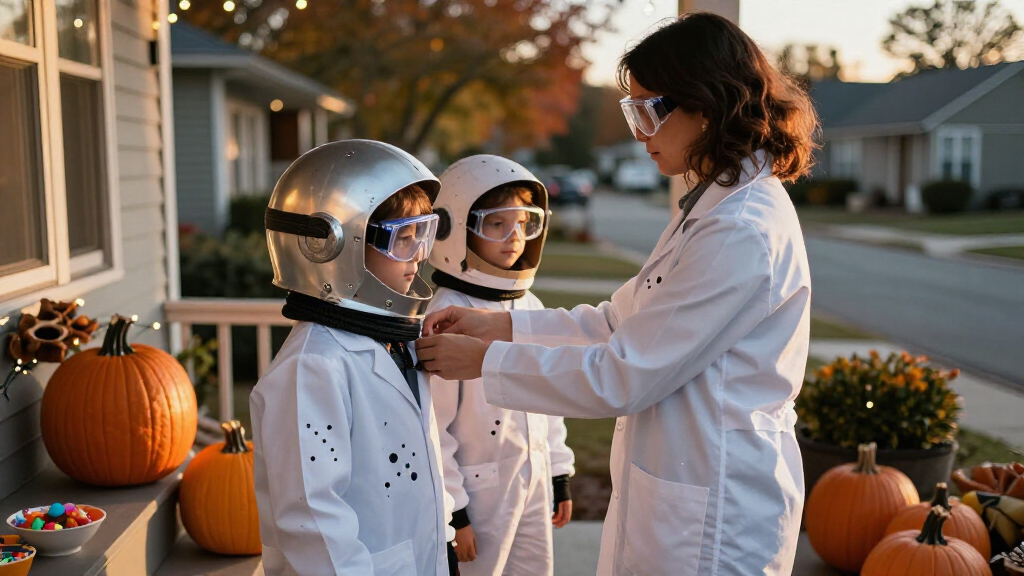
Safe winners include astronaut costumes (white clothes, flag patch, helmet made from a white balloon or a repurposed astronaut helmet), little Marie Curies and Einsteins, planets, and kid-sized DNA helices made from soft felt instead of balloons.
Skip anything with small detachable parts for kids under five, and avoid full-face masks entirely — they restrict peripheral vision during Trick-or-Treat, when visibility matters most. Face paint or a headband costume keeps kids seen and comfortable.
Rule of thumb for kids’ costumes: if they can’t walk up stairs and look both ways while wearing it, simplify it.
The Safety Stuff Nobody Tells You Until Something Goes Wrong
DIY science costumes have three specific hazards worth knowing: flammability, fake chemicals, and visibility. Each has an easy fix — but it helps to understand why each one matters before you decide which precautions are worth your time.
Flammability is the one that can actually hurt someone. Halloween concentrates the two worst ingredients: flammable materials and real flames. Cotton, fleece, and especially synthetic DIY fabrics like tulle and felt can ignite quickly from a jack-o’-lantern candle, and synthetics melt rather than burn, sticking to skin and turning a minor accident into a burn injury. This is why the fix matters more than the effort: spray trailing fabric with a flame-retardant spray ($10 at craft stores), keep hems short, and steer clear of open flames entirely — battery tealights look identical inside a pumpkin. If you’re tempted by dry ice for a “bubbling lab” effect, understand what you’re handling: it’s frozen carbon dioxide at −109°F, so it causes contact burns bare-handed, and as it sublimates it displaces oxygen — a real risk in a car, elevator, or small room. The tradeoff is simple: the effect is great, but it’s only worth it outdoors with insulated gloves and tongs.
Fake chemicals are a legal and social hazard, not just a safety one. A costume prop that looks like a real hazardous substance — a labeled “acid” bottle, an actual cleaner in a flask — can get you stopped by venue security, questioned at a school event, or worse, mistaken for a genuine threat in an era when schools take chemical scares seriously. There’s zero visual payoff you lose by switching: colored water with a pinch of glitter in a sealed flask is indistinguishable at party distance and hurts nobody. The implication is clear — the illusion is free, so never gamble with the real thing.
Visibility cuts both ways. All-black costumes (black holes, spacetime, robots) make you nearly invisible to drivers at dusk — the peak Trick-or-Treat window. The fix costs nothing: reflective tape strips on the back and shoes, a glow stick as an “ion” accessory, or a flashlight in hand. For LED circuit-board costumes, use battery-powered fairy lights only — never anything wired to mains power, both because of electrocution risk and because trailing cords are a trip hazard in crowded rooms.
Frequently Asked Questions
How do I make a science costume without buying a lab coat?
Wear a white button-down shirt backward, buttoned behind you. Add safety goggles from a hardware store ($5), a pocket protector, and messy hair. From any distance, it reads exactly like a lab coat and costs almost nothing.
What are good science costumes for a group or family?
The solar system (one person per planet) and the scientific method (one person per step) are the most popular. Famous duos like the Curies or Watson and Crick also work well. Costs typically run $3–$15 per person with thrift-store materials.
Are there science costumes that require no sewing?
Yes — nearly all of them. Gravity (pinned apples), static cling (pinned socks and balloons), Schrödinger’s cat (a box and cat ears), and the DNA helix (pool noodles and hot glue) all skip the needle entirely. Hot glue and safety pins cover almost every DIY science costume.
What science costumes are appropriate for school parties?
Stick to astronauts, planets, historical scientists, and animals. Avoid gory anatomy, anything with masks (many schools ban them), and props that look like real chemicals. Check your school’s dress code first — most prohibit full-face coverings and face paint.
How much do DIY science costumes usually cost?
Most DIY versions land between $5 and $25 depending on whether you need a base item like goggles or pool noodles. That compares to $40–$70 for typical pre-packaged store costumes — and the DIY versions usually get more attention.
Conclusion
The formula is simple: one clear concept, one good pun or prop, and clothes you already own. Whether it’s apples on a shirt or a cat in a box, the costume people remember is the one that makes them think before they laugh.
So raid the thrift store, grab a backward button-down, and go be the smartest thing at the party. Then send a photo to the one friend who won’t get it — explaining the joke is half the fun.