For most first-time stargazers, I’d start with the Celestron StarSense Explorer LT 127AZ: its larger reflector aperture and phone-assisted sky guidance make it a strong all-around choice. The Celestron AstroMaster LT 70AZ is a simpler refractor option, while the National Geographic NT114CF offers a compact reflector design for buyers who value portability. The main tradeoff is between easier, low-maintenance refractors and reflectors that can gather more light for their size but need more care. Tripod stability, finding targets, and realistic expectations about magnification matter as much as the headline specs. Read on for the full comparison and a guide to choosing among these beginner astronomy telescopes.

Prime made for students and young adults
- Fast, free delivery for dorm and study essentials
- Prime Video and Amazon Music included
- Member-only deals
Key Takeaways
- The StarSense Explorer LT 127AZ stands apart for guided finding and 127mm aperture, pairing help locating objects with more light-gathering ability than the 70mm refractors in this lineup.
- Many of the 70mm refractors share a similar use case: accessible lunar and bright-object viewing, with differences in included accessories and portability more meaningful than advertised magnification.
- The 114mm reflectors offer a different aperture-to-size tradeoff: the Celestron ExploraScope and National Geographic NT114CF can suit buyers seeking more light gathering, but reflector setup and care may be less straightforward.
- Kids-focused scopes prioritize approachability over growth potential: the NASA Lunar Telescope and Nancy B’s MoonScope make sense for guided lunar exploration, not as the strongest long-term all-purpose picks.
- Phone adapters and remotes are extras, not substitutes for stable mounts; a shaky tripod can make aiming and focusing frustrating even when a telescope’s optics are capable.
| Celestron ExploraScope 114AZ Manual Newtonian Reflector Telescope |  | Best for More Light Gathering | Optical design: Newtonian reflector | Aperture: 114 mm | Focal length: 1000 mm | VIEW LATEST PRICE | See Our Full Breakdown |
| Koolpte 70mm Refractor Telescope Kit, 400mm Focal Length | 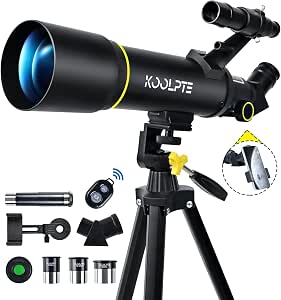 | Best Accessory Bundle for Beginners | Telescope type: Refractor | Aperture: 70 mm | Focal length: 400 mm | VIEW LATEST PRICE | See Our Full Breakdown |
| WOSPO 90mm Aperture Refractor Telescope with Adjustable Tripod and Phone Adapter |  | Best Refractor for Light Gathering | Telescope type: Refractor | Aperture: 90 mm | Focal length: 600 mm | VIEW LATEST PRICE | See Our Full Breakdown |
| Koolpte 80mm Aperture, 600mm AZ Refractor Telescope for Beginners |  | Best Middle-Ground Refractor | Telescope type: Refractor | Aperture: 80 mm | Focal length: 600 mm | VIEW LATEST PRICE | See Our Full Breakdown |
| Fuoibl 70mm Refracting Telescope with Phone Adapter |  | Best Compact Phone-Friendly Pick | Telescope type: Refractor | Objective diameter: 70 mm | Focal length: 300 mm | VIEW LATEST PRICE | See Our Full Breakdown |
| NASA Lunar Telescope for Kids with Tripod and Finder Scope |  | Best for Moon-Focused Young Beginners | Age range: 8 years and up | Objective lens diameter: 25 mm | Maximum magnification: Up to 90x | VIEW LATEST PRICE | See Our Full Breakdown |
| Celestron AstroMaster LT 70AZ 70mm Refractor Telescope |  | Best Straightforward All-Rounder | Optical design: Achromatic refractor | Aperture: 70 mm | Focal length: 900 mm | VIEW LATEST PRICE | See Our Full Breakdown |
| Hawkko 80mm Refractor Telescope Kit for Kids and Beginners |  | Best Beginner Kit for Family Activities | Telescope type: Refractor | Objective lens diameter: 80 mm | Focal length: 500 mm | VIEW LATEST PRICE | See Our Full Breakdown |
| Celestron StarSense Explorer LT 127AZ Beginner Telescope Bundle |  | Best for App-Guided Target Finding | Optical design: Newtonian reflector | Aperture: 127 mm (5 inches) | Mount: Manual altazimuth with altitude slow-motion adjustment | VIEW LATEST PRICE | See Our Full Breakdown |
| Gskyer 70mm Aperture, 400mm Refractor Telescope with Carry Bag, Smartphone Adapter, and Wireless Remote |  | Best Compact Imaging Bundle | Telescope type: Refractor | Objective lens: 70 mm | Focal length: 400 mm (f/5.7) | VIEW LATEST PRICE | See Our Full Breakdown |
| ToyerBee 70mm Aperture Refractor Telescope with Phone Adapter and Tripod |  | Best Beginner Kit for Smartphone Photos | Telescope type: Refractor | Aperture: 70 mm | Focal length: 300 mm | VIEW LATEST PRICE | See Our Full Breakdown |
| 90mm Refractor Telescope with 24x–180x Magnification, Adjustable Tripod and Phone Adapter |  | Best Refractor for a Larger Aperture | Telescope type: Refractor | Aperture: 90 mm | Stated magnification range: 24×–180× | VIEW LATEST PRICE | See Our Full Breakdown |
| National Geographic NT114CF 114 mm Carbon-Fiber Reflector Telescope with Tripod |  | Best for Exploring More Than the Moon | Telescope type: Reflector | Aperture: 114 mm (4.5 in) | Focal length: 500 mm | VIEW LATEST PRICE | See Our Full Breakdown |
| National Geographic 70mm Refractor Telescope with Tripod and Eyepieces |  | Best for Lunar and Planetary Viewing | Telescope type: Refractor | Objective lens diameter: 70 mm | Focal length: 700 mm | VIEW LATEST PRICE | See Our Full Breakdown |
| Educational Insights Nancy B’s Science Club MoonScope Telescope |  | Best Astronomy Activity Set for Kids | Recommended age: 8–11 years | Magnification: 18× and 90× | Eyepieces: 4 mm and 20 mm, all-glass | VIEW LATEST PRICE | See Our Full Breakdown |
| beginner astronomy telescope | Eyepieces | Focal length | Mount | Telescope type |
|---|---|---|---|---|
| Celestron ExploraScope 114AZ M | 20 mm and 4 mm | 1000 mm | Manual alt-azimuth | — |
| Koolpte 70mm Refractor Telesco | K6 mm, K10 mm, K25 mm | 400 mm | Altazimuth | Refractor |
| WOSPO 90mm Aperture Refractor | 25 mm and 10 mm | 600 mm | — | Refractor |
| Koolpte 80mm Aperture | 25 mm and 10 mm Kellner | 600 mm | — | Refractor |
| Fuoibl 70mm Refracting Telesco | 6 mm and 20 mm | 300 mm | — | Refractor |
| NASA Lunar Telescope for Kids | Low-power and high-power | — | Equatorial | — |
| Celestron AstroMaster LT 70AZ | 20 mm and 10 mm | 900 mm | Manual alt-azimuth | — |
| Hawkko 80mm Refractor Telescop | 25 mm and 10 mm | 500 mm | Altazimuth | Refractor |
| Celestron StarSense Explorer L | 25 mm and 10 mm | — | Manual altazimuth with altitude slow-motion adjustment | — |
| Gskyer 70mm Aperture | 25 mm (16x) and 10 mm (40x) | 400 mm (f/5.7) | — | Refractor |
| ToyerBee 70mm Aperture Refract | 20 mm and 6 mm | 300 mm | — | Refractor |
| 90mm Refractor Telescope with | 25 mm and 10 mm Kellner | — | Alt-azimuth | Refractor |
| National Geographic NT114CF 11 | 26 mm and 9.7 mm Plössl | 500 mm | Alt-azimuth | Reflector |
| National Geographic 70mm Refra | Two Plössl eyepieces | 700 mm | Alt-azimuth | Refractor |
| Educational Insights Nancy B’s | 4 mm and 20 mm, all-glass | 396 mm | Alt-azimuth | — |
More Details on Our Top Picks
Celestron ExploraScope 114AZ Manual Newtonian Reflector Telescope
The 114 mm reflector aperture gives this Celestron a light-gathering advantage over the 70 mm Koolpte and Fuoibl refractors in this batch, making it a stronger fit for beginners hoping to explore beyond the Moon and the brightest targets. Its manual alt-azimuth mount keeps pointing straightforward, while the red-dot finder helps newcomers aim without relying on a phone. At 6.7 pounds with tool-free setup, it is also easier to take outside than its larger aperture might suggest. The tradeoff is hands-on tracking: the user must keep objects centered, and the supplied 4 mm eyepiece and 3× Barlow do not make the advertised maximum magnification a practical everyday target. Choose this over the smaller refractors for aperture; choose a refractor if you prefer a simpler optical layout.
Pros:- 114 mm aperture gathers more light than the 70 mm refractors in this group
- Fully coated glass optics
- Includes 20 mm and 4 mm eyepieces, a 3× Barlow, and a red-dot finder
- Lightweight 6.7-pound kit with quick, tool-free setup
Cons:- Manual alt-azimuth mount requires the user to aim and keep targets centered
- The advertised 750× maximum relies on the eyepiece and Barlow combination and is not a realistic expectation for routine viewing
Best for: Beginners who want a lightweight telescope with more aperture for exploring the Moon and brighter deep-sky targets, and are willing to aim and track manually
Not ideal for: First-time observers who want phone-guided locating or automatic tracking, or anyone expecting sharp, steady views at the advertised maximum magnification
- Optical design:Newtonian reflector
- Aperture:114 mm
- Focal length:1000 mm
- Mount:Manual alt-azimuth
- Eyepieces:20 mm and 4 mm
- Optics:Fully coated glass
- Weight:6.7 lbs
- Included accessories:3× Barlow lens, StarPointer red-dot finderscope, adjustable tripod, accessory tray
Our verdict“Pick the ExploraScope if aperture matters more than guided tracking and you are comfortable steering the telescope by hand.”
Koolpte 70mm Refractor Telescope Kit, 400mm Focal Length
The Koolpte 40070 is the most accessory-forward choice here: its three eyepieces, 3× Barlow, smartphone adapter, and wireless remote give a new observer several ways to experiment without assembling a separate starter kit. Its 400 mm focal length and 70 mm aperture make it a compact option for the Moon and other bright targets, while the 5×24 finder helps with initial aiming. Compared with the 80 mm Koolpte, it gives up aperture, so it is less compelling if light gathering is the priority. It also has a shorter focal length than that model and the WOSPO 90 mm, making this a better match for portability and accessory variety than for chasing fine detail. The manual focus and altazimuth mount still require patient hands-on adjustments; the included extras do not automate observing.
Pros:- Three eyepieces and a 3× Barlow offer several magnification combinations
- Includes a smartphone adapter and wireless remote
- Compact 40 cm optical tube and adjustable aluminum tripod
- 5×24 finder with crosshair lines supports basic aiming
Cons:- 70 mm aperture gathers less light than the 80 mm Koolpte and 90 mm WOSPO
- Manual focus and altazimuth pointing require hands-on adjustments
- The stated 200× upper magnification depends on the included eyepiece and Barlow combination
Best for: New observers or families who want a portable starter kit with multiple eyepieces and phone-shooting accessories for bright, easy-to-find targets
Not ideal for: Buyers prioritizing aperture or detailed views of dimmer objects, since its 70 mm opening is smaller than the 80 mm Koolpte and 90 mm WOSPO
- Telescope type:Refractor
- Aperture:70 mm
- Focal length:400 mm
- Focal ratio:f/5.7
- Mount:Altazimuth
- Eyepieces:K6 mm, K10 mm, K25 mm
- Magnification:20×–200×
- Included accessories:3× Barlow lens, smartphone adapter, wireless remote, adjustable aluminum tripod, 5×24 finderscope
Our verdict“Choose this Koolpte for a portable, accessory-rich introduction to bright targets rather than for maximum light gathering.”
WOSPO 90mm Aperture Refractor Telescope with Adjustable Tripod and Phone Adapter
Among the refractors in this batch, the 90 mm aperture gives the WOSPO the strongest light-gathering case, ahead of the 80 mm Koolpte and both 70 mm models. Its 600 mm focal length, two eyepieces, and 3× Barlow provide a useful range for moving between wider views and closer looks at bright targets. Fully multi-coated optics and the included 45° diagonal support a more comfortable viewing setup, while the carrying case helps with storage and transport. This is the better pick than the shorter 400 mm Koolpte when aperture and a longer tube take precedence over a compact kit. There are tradeoffs: it still uses a manual altazimuth mount and focus, and the listed 180× ceiling depends on the Barlow rather than guaranteeing useful detail at that power.
Pros:- 90 mm aperture is larger than the other refractors in this five-product group
- Fully multi-coated optics
- Includes 25 mm and 10 mm eyepieces, a 3× Barlow, and a 45° diagonal
- Carrying case, phone adapter, and adjustable 29–49 inch tripod add practical flexibility
Cons:- Manual focus and altazimuth mount require the observer to make adjustments
- The stated 180× upper magnification depends on using the Barlow and is not a promise of clear views at that power
- Its 60 cm optical tube is less compact than the 30–40 cm tubes of the smaller refractors
Best for: Beginners who want a refractor with more aperture than the 70 mm and 80 mm options, plus a carrying case and phone adapter
Not ideal for: Travelers seeking the shortest, lightest setup or observers who want automatic tracking and minimal manual adjustments
- Telescope type:Refractor
- Aperture:90 mm
- Focal length:600 mm
- Magnification:24×–180× with 3× Barlow lens
- Eyepieces:25 mm and 10 mm
- Optics coating:Fully multi-coated
- Mount and focus:Altazimuth mount; manual focus
- Included accessories:3× Barlow lens, 3×24 finderscope, 45° diagonal mirror, phone adapter, carrying case
Our verdict“Pick the WOSPO if you want the largest refractor aperture in this batch and can accept a longer tube and manual operation.”
Koolpte 80mm Aperture, 600mm AZ Refractor Telescope for Beginners
The 80 mm Koolpte sits between the 70 mm Koolpte 40070 and the 90 mm WOSPO: it offers more aperture than the smaller starter refractors without stepping up to the largest refractor in this batch. Its 600 mm focal length and 25 mm and 10 mm eyepieces make it a straightforward kit for learning to find and view bright celestial targets. The fully multi-coated optics, phone adapter, wireless remote, and carrying bag add useful extras, while tool-free setup keeps the first session simple. Compared with the WOSPO, it gives up 10 mm of aperture and a carrying case in exchange for a two-year warranty listed in the product data. The manual altazimuth mount remains a hands-on system, and the Barlow’s advertised higher magnifications should not be confused with consistently useful detail.
Pros:- 80 mm aperture sits above the 70 mm refractors in this batch
- Fully multi-coated optics and 600 mm focal length
- Includes two eyepieces, a 3× Barlow, phone adapter, wireless remote, and carrying bag
- Tool-free setup and a stated two-year warranty
Cons:- The 90 mm WOSPO has a larger aperture for buyers prioritizing light gathering
- Manual focus and altazimuth mounting require ongoing hands-on adjustment
- Higher listed magnifications depend on the Barlow and do not guarantee clear detail
Best for: Beginners who want a medium-aperture refractor with basic phone-capture accessories, a carrying bag, and a stated two-year warranty
Not ideal for: Observers who want the greatest refractor aperture in this group or prefer a mount that tracks targets without manual input
- Telescope type:Refractor
- Aperture:80 mm
- Focal length:600 mm
- Focal ratio:f/6.7
- Mount and focus:Altazimuth mount; manual focus
- Eyepieces:25 mm and 10 mm Kellner
- Magnification:24× and 60×; up to 72× and 180× with 3× Barlow lens
- Included accessories:5×24 finder scope, adjustable aluminum tripod, phone adapter, wireless remote, carrying bag
Our verdict“Choose the 80 mm Koolpte as a balanced starter refractor if its included accessories matter more than stepping up to the WOSPO’s larger aperture.”
Fuoibl 70mm Refracting Telescope with Phone Adapter
The Fuoibl’s 30 cm optical tube and 70 mm aperture make it the compact option in this group, with a phone adapter and wireless remote for beginners who want to try capturing bright targets. Its 300 mm focal length is shorter than the 400 mm Koolpte and 600 mm models, favoring a small, portable setup over the longer focal length of the WOSPO or 80 mm Koolpte. The supplied 20 mm and 6 mm eyepieces plus 3× Barlow provide choices, but the stated 150× maximum is not a measure of how much useful detail the telescope will show. Like the other refractors here, it needs manual focus and aiming. The product data also notes that the 5×24 finderscope shows an inverted image, which may add confusion for a first-time user.
Pros:- Short 30 cm optical tube supports a compact setup
- Fully multi-coated 70 mm objective
- Includes 20 mm and 6 mm eyepieces, a 3× Barlow, phone adapter, and wireless remote
- Adjustable tripod extends up to 45 inches
Cons:- 70 mm aperture is smaller than the 80 mm Koolpte and 90 mm WOSPO
- The 5×24 finderscope displays an inverted image, which can complicate aiming
- Manual focus and altazimuth pointing require hands-on adjustments
Best for: Beginners seeking a compact, phone-friendly refractor for the Moon, bright planets, and daytime scenery who value portability over aperture
Not ideal for: Buyers who want the largest aperture in this batch, a longer focal length, or an especially intuitive finder for learning to aim
- Telescope type:Refractor
- Objective diameter:70 mm
- Focal length:300 mm
- Optics:Fully multi-coated
- Mount and focus:Altazimuth mount; manual focus
- Eyepieces:6 mm and 20 mm
- Magnification:15×–150×
- Included accessories:3× Barlow lens, 5×24 finderscope, adjustable tripod, phone adapter, wireless remote
Our verdict“Choose the Fuoibl for a compact refractor with phone accessories, but favor the WOSPO or 80 mm Koolpte if aperture is your priority.”
NASA Lunar Telescope for Kids with Tripod and Finder Scope
For a child whose first astronomy goal is finding the Moon and tracing its surface, this compact kit keeps the learning curve centered on one rewarding target. The finder scope helps with aiming, while two eyepieces offer a choice of lower- and higher-power views. Its tabletop tripod and smooth mount are suited to scanning lunar features from a stable surface, and the NASA-branded guide gives the activity an educational focus. Compared with the Celestron AstroMaster LT 70AZ, this is more narrowly aimed at children and lunar observing; the Celestron is the more flexible choice for planets, star clusters, and daytime scenery. The tradeoff is clear: 90x maximum magnification does not make this a broad-scope observing setup, and the tabletop tripod is not designed for standing-height use.
Pros:- Two eyepieces provide lower- and higher-power viewing options.
- Straight-through finder scope helps beginners aim at the Moon.
- Tabletop tripod and smooth mount support steady lunar scanning.
- NASA-branded learning guide adds an educational activity.
Cons:- Tabletop tripod limits comfortable use to a suitable raised surface.
- The product is geared mainly toward lunar observing rather than a broad range of astronomical targets.
Best for: Children ages 8 and up who want a guided first telescope activity focused mainly on the Moon and can observe from a table.
Not ideal for: Beginners seeking a full-height tripod or one telescope for a wider range of night-sky targets.
- Age range:8 years and up
- Objective lens diameter:25 mm
- Maximum magnification:Up to 90x
- Eyepieces:Low-power and high-power
- Finder scope:Straight-through
- Mount:Equatorial
- Field of view:0.85 degrees
- Included tripod:Tabletop
Our verdict“Choose this for a child’s Moon-centered introduction to astronomy, but pick the Celestron AstroMaster LT 70AZ for more varied observing and a full-height tripod.”
Celestron AstroMaster LT 70AZ 70mm Refractor Telescope
I’d put the AstroMaster LT 70AZ near the top of a beginner’s shortlist when ease of use matters more than app-guided target finding. Its manual alt-azimuth mount moves in familiar up-down and side-to-side directions, and the adjustable full-height tripod is more practical for standing backyard sessions than the tabletop support on the NASA Lunar Telescope for Kids. The 70mm refractor is suited to the Moon, planets, star clusters, and daytime scenery; its erect image diagonal also keeps terrestrial views right-side-up. Two eyepieces offer 35x and 70x views, while the red dot finder helps with aiming. The tradeoff is that this remains a manual telescope: finding and following targets depends on the user, unlike the phone-guided Celestron StarSense Explorer LT 127AZ. Its aperture also limits how much faint detail it can show.
Pros:- 70mm coated refractor optics suit bright celestial targets and daytime scenery.
- Full-height adjustable tripod offers a more natural observing position than a tabletop setup.
- Alt-azimuth mount is intuitive for manual aiming.
- Erect image diagonal supports right-side-up land views.
Cons:- Manual aiming and tracking require the user to locate and follow targets.
- The 70mm aperture is better suited to beginner targets than faint deep-sky observing.
Best for: New observers who want a full-height, manually operated telescope for the Moon, bright planets, and occasional daytime viewing.
Not ideal for: Beginners who want smartphone guidance to locate targets or expect detailed views of faint deep-sky objects.
- Optical design:Achromatic refractor
- Aperture:70 mm
- Focal length:900 mm
- Mount:Manual alt-azimuth
- Eyepieces:20 mm and 10 mm
- Magnification:35x and 70x
- Finderscope:StarPointer red dot
- Assembled weight:7.2 lb (3.27 kg)
Our verdict“Pick the AstroMaster LT 70AZ for simple, versatile manual viewing, or choose the StarSense Explorer LT 127AZ if app-assisted target finding and more aperture matter more.”
Hawkko 80mm Refractor Telescope Kit for Kids and Beginners
The Hawkko’s strongest case is not just its 80mm aperture; it is the activity-focused kit around it. A backpack, phone adapter, Moon booklet, and observation log give families ways to make observing part of a repeatable project, while the 25mm and 10mm eyepieces cover two basic viewing powers. The 500mm focal length and refractor design suit bright targets such as the Moon as well as landscapes and nature. Compared with the Gskyer 70mm 400mm Refractor, Hawkko has a larger stated objective and more explicit learning materials, while Gskyer includes a wireless camera remote. Hawkko’s manual altazimuth setup still leaves focusing and target tracking to the user, and the listed 20x–150x range should not be mistaken for equally useful detail at every setting. It is a beginner activity kit, not an advanced observing instrument.
Pros:- 80mm objective lens gathers more light than the 70mm refractors in this batch.
- Backpack and adjustable tripod support portable observing sessions.
- Phone adapter, Moon booklet, and observation log encourage hands-on activities.
- Two eyepieces and a 3x Barlow provide several magnification combinations.
Cons:- Manual focusing and altazimuth aiming require active adjustment by the user.
- The broad magnification range does not mean every setting will provide useful detail.
Best for: Families with children who want a portable starter telescope paired with guided Moon activities, an observation log, and phone-based image capture.
Not ideal for: Observers seeking automated tracking, advanced optics, or a telescope chosen primarily for high-magnification planetary detail.
- Telescope type:Refractor
- Objective lens diameter:80 mm
- Focal length:500 mm
- Magnification range:20x–150x
- Eyepieces:25 mm and 10 mm
- Barlow lens:3x
- Mount:Altazimuth
- Included accessories:Phone adapter, backpack, Moon and space guides, observation log
Our verdict“Choose Hawkko for a family-friendly observing kit with learning materials and portability; choose the Gskyer instead if its wireless camera remote is a higher priority.”
Celestron StarSense Explorer LT 127AZ Beginner Telescope Bundle
Among these five options, the StarSense Explorer LT 127AZ makes the most sense for beginners who want help deciding where to point. Its StarSense Explorer app guides users toward celestial objects, addressing a common early hurdle that the manual AstroMaster LT 70AZ leaves entirely to the observer. A 127mm Newtonian reflector also gives it a substantial aperture advantage over the 70mm and 80mm refractors here, making it the more capable choice for the Moon, planets, and bright deep-sky targets. The bundle adds two eyepieces, a 2x Barlow, Moon filter, Moon map, and phone adapter. That extra capability comes with setup and tracking demands: the mount is still manual, so users must follow targets themselves, and the StarPointer needs two user-supplied AAA batteries. This is the most ambitious beginner pick, not the simplest grab-and-go option.
Pros:- StarSense Explorer app helps beginners locate celestial targets.
- 127mm aperture offers more light-gathering capacity than the smaller refractors in this batch.
- Bundle includes two eyepieces, a Barlow lens, Moon filter, and Moon map.
- Phone adapter supports smartphone use alongside the observing accessories.
Cons:- Manual altazimuth mount still requires the user to track moving targets.
- Two AAA batteries for the StarPointer are not included.
- The bundle and reflector setup may involve more to manage than a basic refractor.
Best for: First-time observers who want smartphone guidance to locate targets and enough aperture to explore beyond the Moon and bright planets.
Not ideal for: Buyers who want a very simple, lightweight refractor with minimal setup or do not want to manage a manual mount and app-based workflow.
- Optical design:Newtonian reflector
- Aperture:127 mm (5 inches)
- Mount:Manual altazimuth with altitude slow-motion adjustment
- Smartphone app:StarSense Explorer
- Eyepieces:25 mm and 10 mm
- Included accessories:2x Barlow lens, Moon filter, Moon map, smartphone adapter
- StarPointer power:Two user-supplied AAA batteries
- Warranty:2-year US warranty
Our verdict“Choose this if phone-guided locating and greater aperture are your priorities; opt for the AstroMaster LT 70AZ for a simpler, more straightforward manual refractor.”
Gskyer 70mm Aperture, 400mm Refractor Telescope with Carry Bag, Smartphone Adapter, and Wireless Remote
Gskyer is the portability pick for beginners who want a short refractor and phone accessories in one package. At 400mm focal length, it is more compact in design than the 900mm Celestron AstroMaster LT 70AZ, and the carry bag supports taking the kit to a darker site or a daytime viewing spot. The included 25mm and 10mm eyepieces provide 16x and 40x, while the 3x Barlow extends the available combinations; the phone adapter and wireless remote are aimed at casual image capture. Its 70mm aperture is suited to bright targets, but it gathers less light than the Hawkko 80mm and far less than the 127mm StarSense reflector. The mount and focus remain manual, so users must point, focus, and track for themselves. Treat the stated 120x maximum as a limit, not a promise of sharp views at that power.
Pros:- Short 400mm focal length and included carry bag suit portable use.
- Two eyepieces and a 3x Barlow offer several viewing combinations.
- Phone adapter and wireless remote support casual image capture.
- Erecting BAK4 prism provides an upright image for terrestrial viewing.
Cons:- 70mm aperture is less capable for faint targets than Hawkko’s 80mm or the StarSense 127mm reflector.
- Manual focus and altazimuth mount require the user to make adjustments and track targets.
- The stated 120x maximum magnification may not deliver useful detail in typical beginner observing conditions.
Best for: Beginners seeking a portable 70mm refractor with a carry bag and simple smartphone imaging accessories for bright targets and daytime scenes.
Not ideal for: Observers prioritizing greater light gathering, app-guided target locating, or detailed views of faint objects.
- Telescope type:Refractor
- Objective lens:70 mm
- Focal length:400 mm (f/5.7)
- Eyepieces:25 mm (16x) and 10 mm (40x)
- Barlow lens:3x
- Maximum magnification:120x
- Finderscope:5×24 with cross-hair lines
- Included accessories:Carry bag, smartphone adapter, wireless camera remote
Our verdict“Pick the Gskyer for a portable refractor-and-phone bundle, but choose the Hawkko for a larger aperture or the StarSense LT 127AZ for more ambitious celestial observing.”
ToyerBee 70mm Aperture Refractor Telescope with Phone Adapter and Tripod
The ToyerBee is a straightforward starter for someone who wants a telescope and a simple way to try phone photography in one package. Its 70mm aperture is suited to the Moon and other bright targets, while the 300mm focal length gives a relatively wide view that can make finding objects less fussy. The included phone adapter and wireless remote add a practical photo option, and the star chart offers a starting point for learning the sky. Compared with the National Geographic 70mm Refractor, this model has a shorter focal length and a lower stated maximum magnification, so it is less geared toward tighter views of lunar and planetary details. The tradeoff is a kit-oriented setup with manual focusing; the advertised 150× ceiling should not be read as a guarantee of useful detail in every condition.
Pros:- 70mm aperture and fully multi-coated optics suit bright targets such as the Moon.
- 20mm and 6mm eyepieces plus a 3× Barlow offer several magnification combinations.
- Phone adapter and wireless remote support basic smartphone capture.
- Star chart and tool-free setup make it approachable for a first telescope.
Cons:- Manual focusing and aiming require hands-on adjustments.
- The 300mm focal length is less suited to tight views of planets than the National Geographic 70mm Refractor’s 700mm focal length.
- The included battery is described as nonstandard.
Best for: First-time observers who want a lightweight, accessory-rich telescope for the Moon, bright objects, and occasional smartphone snapshots.
Not ideal for: Buyers focused on close planetary views or expecting reliable high-magnification detail; its short focal length and manual setup favor simpler, wider viewing.
- Telescope type:Refractor
- Aperture:70 mm
- Focal length:300 mm
- Optics:Fully multi-coated
- Eyepieces:20 mm and 6 mm
- Barlow lens:3×
- Stated magnification range:15×–150×
- Finderscope:5×24
- Weight:3.5 lb
Our verdict“Choose the ToyerBee if you want a light, phone-ready starter for bright objects, but not if high-magnification planetary viewing is your priority.”
90mm Refractor Telescope with 24x–180x Magnification, Adjustable Tripod and Phone Adapter
This 90mm refractor offers a meaningful step up in light-gathering aperture from the 70mm ToyerBee and National Geographic refractor, which can help when observing the Moon and other bright celestial targets. Its 25mm and 10mm eyepieces, paired with a 3× Barlow, let beginners try different views without buying extra optics. The 29–49-inch adjustable tripod and carrying case also make it more adaptable to different observers and outings than a fixed-height setup. An erect-image diagonal keeps terrestrial scenery upright, adding daytime use. The tradeoff is that this is still a manual alt-azimuth telescope: users need to focus and track objects themselves. Its stated 180× maximum is a range claim, not a promise that the atmosphere or optics will deliver sharp views at that level; the 114mm National Geographic reflector is the stronger fit for wider-ranging celestial observing.
Pros:- 90mm aperture provides more light-gathering area than the 70mm refractors in this group.
- 25mm and 10mm eyepieces with a 3× Barlow give flexible magnification choices.
- Adjustable 29–49-inch tripod accommodates different viewing heights.
- Erect-image diagonal supports upright terrestrial viewing as well as astronomy.
Cons:- Manual focus and alt-azimuth operation require the observer to make adjustments.
- The 180× maximum may not produce useful detail under typical viewing conditions.
- Compared with the National Geographic NT114CF, it offers less aperture for observing a broader range of celestial targets.
Best for: Beginners who want a 90mm refractor for Moon viewing and daytime scenery, with an adjustable tripod and a case for transport.
Not ideal for: Buyers seeking push-button tracking or consistently sharp views at the advertised maximum magnification; operation and focus are manual.
- Telescope type:Refractor
- Aperture:90 mm
- Stated magnification range:24×–180×
- Eyepieces:25 mm and 10 mm Kellner
- Barlow lens:3×
- Mount:Alt-azimuth
- Finderscope:3×24
- Tripod height:29–49 in
- Field of view:2 degrees
Our verdict“Pick this model if a larger-aperture refractor and adjustable, portable setup matter more than automatic tracking or high-magnification certainty.”
National Geographic NT114CF 114 mm Carbon-Fiber Reflector Telescope with Tripod
The NT114CF stands apart from the smaller refractors here through its 114mm reflector aperture and short 500mm focal length. That combination gives beginners a wider-field route to star clusters and brighter nebulae, alongside the Moon and planets. Its 26mm and 9.7mm Plössl eyepieces, 2× Barlow, and red-dot finder provide a usable starting set, while the alt-azimuth mount keeps movement intuitive. Compared with the 90mm refractor in this batch, the NT114CF has more aperture and is better positioned for exploring a broader selection of bright deep-sky objects. It does not offer the refractor’s erect-image terrestrial view, though, and its stated magnification tops out at 102×. The smartphone adapter supports entry-level experiments, not advanced astrophotography; buyers should choose it for visual observing rather than expecting a dedicated imaging platform.
Pros:- 114mm aperture gathers more light than the 70mm and 90mm refractors in this group.
- 500mm focal length and f/4.4 optics support wide-field viewing.
- Includes two Plössl eyepieces, a 2× Barlow, and a red-dot finder.
- Intuitive alt-azimuth movement and smartphone adapter suit entry-level observing.
Cons:- Maximum stated magnification is 102×, limiting its reach for tighter planetary views.
- Manual aiming and focus require the observer to track objects by hand.
- Smartphone adapter is for entry-level capture, not advanced astrophotography.
Best for: Beginners who want to move beyond lunar viewing and try wide-field views of star clusters and brighter nebulae.
Not ideal for: Buyers who want upright daytime scenery, advanced astrophotography capability, or very high magnification for planetary viewing.
- Telescope type:Reflector
- Aperture:114 mm (4.5 in)
- Focal length:500 mm
- Focal ratio:f/4.4
- Mount:Alt-azimuth
- Eyepieces:26 mm and 9.7 mm Plössl
- Barlow lens:2×
- Maximum magnification:Up to 102×
- Finder:Red-dot reflex finder
Our verdict“Choose the NT114CF if your beginner goal includes star clusters and brighter nebulae, rather than only the Moon and daytime scenery.”
National Geographic 70mm Refractor Telescope with Tripod and Eyepieces
Among the refractors in this group, this National Geographic model is the better fit for beginners who want to concentrate on the Moon and planets. Its 700mm focal length is more than twice the ToyerBee’s 300mm, favoring tighter views when paired with the supplied eyepieces and 2× Barlow. A red-dot finder helps with initial aiming, and the full-size adjustable tripod with panhandle control gives users a familiar way to point the telescope. The smartphone adapter adds a simple path to trying lunar snapshots. Compared with the ToyerBee, it gives up the shorter model’s wider-field emphasis and wireless remote, but it offers a longer focal length and Plössl eyepieces. Like the other manual refractors here, it still demands hands-on focus and tracking; its 70mm aperture is better suited to bright targets than faint deep-sky objects.
Pros:- 700mm focal length favors tighter views than the ToyerBee’s 300mm design.
- Two Plössl eyepieces and a 2× Barlow provide several magnification options.
- Red-dot viewfinder helps beginners aim at bright targets.
- Full-size adjustable tripod and smartphone adapter are included.
Cons:- 70mm aperture is better suited to bright objects than faint deep-sky targets.
- Manual focus and alt-azimuth pointing require frequent hands-on adjustment.
- Its longer focal length is less geared toward wide-field views than the National Geographic NT114CF reflector.
Best for: New observers who mainly want to view the Moon and bright planets with a longer-focal-length refractor and full-size tripod.
Not ideal for: Beginners whose main goal is faint deep-sky observing or wide-field exploration; its 70mm aperture and longer focal length are better matched to bright targets.
- Telescope type:Refractor
- Objective lens diameter:70 mm
- Focal length:700 mm
- Mount:Alt-azimuth
- Eyepieces:Two Plössl eyepieces
- Additional lens:2× Barlow lens
- Magnification options:26.9×, 53.8×, 72×, and 144×
- Finderscope:Reflex red dot
- Field of view:1.02 degrees
Our verdict“Choose this refractor for a beginner setup centered on the Moon and bright planets, not for broad deep-sky exploration.”
Educational Insights Nancy B’s Science Club MoonScope Telescope
The MoonScope is the most child-focused pick in this group: its 18× and 90× magnifications, moon filter, glow-in-the-dark finder, and built-in red LED make the observing session part of a guided activity rather than a bare telescope setup. The included 22-page journal gives children aged 8–11 projects to pair with looking at the Moon and other bright objects. Compared with the ToyerBee and National Geographic refractors, this model puts less emphasis on a broad accessory kit for smartphone photography and more on hands-on learning. That focus suits a young first-time observer, but the limited magnification choices and manual operation leave less room to adapt as skills grow. Adults seeking a more versatile telescope for planets, terrestrial scenery, or wider target selection may be better served by the 90mm refractor or NT114CF.
Pros:- Two magnification settings offer simple choices for lunar and bright-object viewing.
- Moon filter is included for lunar observing.
- Glow-in-the-dark finder and built-in red LED support use in low light.
- 22-page activity journal gives children structured astronomy projects.
Cons:- Manual focusing and operation require adult guidance for some young users.
- Its child-oriented feature set is less versatile than the 90mm refractor or National Geographic NT114CF.
- Not suitable for children under 3 because of small parts.
Best for: Families introducing children aged 8–11 to the Moon and basic astronomy through guided activities and simple observing sessions.
Not ideal for: Adults or older beginners who want a versatile telescope with multiple eyepiece options, broader target range, or smartphone capture accessories.
- Recommended age:8–11 years
- Magnification:18× and 90×
- Eyepieces:4 mm and 20 mm, all-glass
- Focal length:396 mm
- Field of view:1.5 degrees
- Mount:Alt-azimuth
- Finder scope:Glow-in-the-dark
- Included accessories:Moon filter, tripod with built-in red LED, 22-page activity journal
Our verdict“Pick the MoonScope for a child’s first guided astronomy activities, but choose a larger, more versatile model for an adult beginner.”
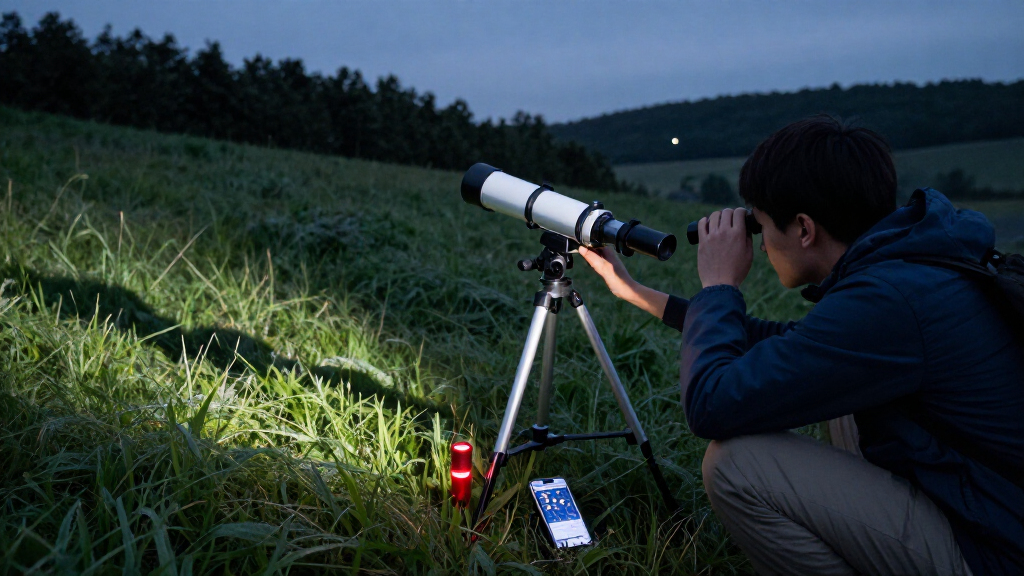
How We Picked
I ranked these beginner astronomy telescopes by how well they support a first observing experience, not by magnification claims alone. I weighed aperture and optical design against practical factors: mount stability, ease of aiming, assembly, portability, included accessories, and the likely learning curve. A scope that helps a beginner find and keep a target in view earns more credit than one that advertises high magnification but offers little help at the eyepiece.
The ranking favors useful capability paired with manageable operation. That puts the StarSense Explorer LT 127AZ near the top for its combination of aperture and guided sky-finding, while simpler 70mm refractors rank well for buyers who want an approachable lunar and bright-object scope. Reflectors are judged for their potential light gathering as well as their added care needs; kids’ models are assessed as entry points for supervised learning, not as substitutes for more capable general-purpose telescopes. Product details can vary by bundle, so I also treat accessories as useful only when they solve a real setup or observing problem.
| beginner astronomy telescope | Mount | Telescope type |
|---|---|---|
| Celestron ExploraScope 114AZ M | Manual alt-azimuth | — |
| Koolpte 70mm Refractor Telesco | Altazimuth | Refractor |
| WOSPO 90mm Aperture Refractor | — | Refractor |
| Koolpte 80mm Aperture | — | Refractor |
| Fuoibl 70mm Refracting Telesco | — | Refractor |
| NASA Lunar Telescope for Kids | Equatorial | — |
| Celestron AstroMaster LT 70AZ | Manual alt-azimuth | — |
| Hawkko 80mm Refractor Telescop | Altazimuth | Refractor |
| Celestron StarSense Explorer L | Manual altazimuth with altitude slow-motion adjustment | — |
| Gskyer 70mm Aperture | — | Refractor |
| ToyerBee 70mm Aperture Refract | — | Refractor |
| 90mm Refractor Telescope with | Alt-azimuth | Refractor |
| National Geographic NT114CF 11 | Alt-azimuth | Reflector |
| National Geographic 70mm Refra | Alt-azimuth | Refractor |
| Educational Insights Nancy B’s | Alt-azimuth | — |
Factors to Consider When Choosing Beginner Astronomy Telescopes
Choosing a first telescope is less about chasing the biggest number on the box and more about matching the instrument to where and how you plan to observe. I’d weigh your observing location, patience for setup, and whether you’ll use it with children before comparing accessory lists.
Choose aperture for the views you want, not a magnification claim
Aperture controls how much light the telescope collects, which affects how much detail you can see and how well the scope handles dimmer targets. A larger aperture can help, but it does not guarantee crisp views if the mount is unstable, the optics are poorly aligned, or the sky conditions are poor. For a first scope focused on the Moon and bright objects, a smaller refractor can still be satisfying and straightforward. Avoid treating a high maximum-magnification figure as a promise of useful detail; magnification depends on eyepieces, optics, atmosphere, and steadiness. Decide which targets matter to you before paying extra for size you may find difficult to store or set up.
Refractor or reflector: trade simplicity for light gathering
Refractors are usually easier to maintain because their optical path is enclosed, and many entry-level models are ready for basic viewing with little adjustment. Reflectors can provide more aperture for their footprint, which can be appealing when you want to explore beyond the brightest targets. Their mirrors may need occasional alignment, and the open tube can collect dust, so they ask a little more of the owner. Neither design is automatically better for every beginner. If you want quick sessions with minimal fuss, favor simplicity; if you’re willing to learn basic upkeep in exchange for aperture, a reflector may fit better.
Treat the mount as part of the optical system
A steady mount makes focusing and tracking easier, while vibration can turn a clear view into a difficult one. Lightweight tripods help with carrying a telescope, but they may be less settled on uneven ground or when touched. Before buying, think about where the scope will sit and whether you can give it a firm surface. A phone adapter can help capture or share a view, but it adds weight and does not fix wobble. For beginners, a stable, uncomplicated mount is often more useful than a long accessory list.
Make target-finding part of your decision
Finding an object is a separate skill from viewing it, and a telescope with a narrow field of view can make that first step challenging. A finder scope or phone-guided system may reduce the time spent searching, especially for someone new to the sky. These aids still require setup and learning, so check whether you’re comfortable using a phone outdoors and keeping its screen dim. If you prefer a simpler instrument, begin with easy targets such as the Moon and learn how the finder aligns with the main telescope. Don’t assume that a powerful telescope will automatically make locating objects easier.
Match portability to your actual observing routine
The best scope is one you can readily take outside, whether that means a quick trip to a balcony, a backyard session, or travel to darker skies. A compact kit may be easier to store and carry, but a smaller instrument can limit what you see compared with a larger-aperture model. Check the packed size, tripod setup, and whether accessories have a practical place to go. If you’ll observe from a fixed spot, portability may matter less than mount stability. If travel is part of the plan, decide how much bulk you’ll realistically carry before choosing a larger setup.
Set expectations for phones, children, and nighttime use
Phone accessories are best treated as optional learning tools, not as a shortcut to professional-looking astrophotography. Holding a phone over an eyepiece takes alignment and patience, and results depend on the target, focus, and steadiness. For a child, prioritize safe handling, a manageable setup, and an adult’s help with aiming rather than a long list of technical features. A lunar-focused kit can be a good introduction if the child’s interest is still developing, while a more capable general-purpose scope may suit a family that expects to keep observing. Also plan for dark adaptation, comfortable clothing, and a place to put small eyepieces so sessions remain enjoyable.
Frequently Asked Questions
Should I choose the 127mm StarSense reflector or a simpler 70mm refractor as my first telescope?
Choose the StarSense Explorer LT 127AZ if guided target-finding and greater aperture matter more to you than having the simplest possible setup. A 70mm refractor is a sensible fit for someone focused on the Moon and bright objects who wants a more straightforward instrument. Reflectors can involve extra care, including checking optical alignment, while phone guidance does not remove the need to learn basic telescope handling. Consider where you’ll store the scope and whether you’re comfortable with a larger setup. If ease of use is your main priority, the simpler refractor may be the better first step.
Can a beginner telescope show planets clearly, or should I expect mostly Moon viewing?
Many scopes in this roundup can show the Moon well and may reveal bright planets as small disks, but the level of detail will be limited by aperture, optical quality, atmospheric conditions, and magnification. A planet usually won’t fill the eyepiece with the dramatic detail seen in processed images. Steady skies and careful focusing can matter more than selecting the highest-magnification eyepiece. If planets are your main goal, prioritize stable mounting and useful optics over phone accessories. The Moon remains the most forgiving starting target while you learn to focus and aim.
Are phone adapters useful for learning astronomy, or are they mostly for photos?
A phone adapter can help you share a view or try basic eyepiece photography, but it is not required to learn the night sky. Aligning a phone camera with an eyepiece can take patience, and a small movement may spoil the image. Phone-guided systems serve a different purpose: they can help identify where to aim, though they still require setup and attention to the sky. If you’re choosing between a phone adapter and a steadier tripod or better target-finding aid, I’d prioritize the latter. Treat phone photography as an extra rather than the main reason to buy a telescope.
Is a telescope marketed for kids a good choice for an adult beginner too?
It can be, if the adult’s expectations match the scope’s design and intended use. Kid-focused models can introduce basic observing in a manageable way, particularly for Moon viewing and supervised family sessions. They may be less appealing as a long-term general-purpose instrument if you want broader observing capability or room to develop new skills. Compare the mount, finder, and optical details with the adult-oriented models rather than relying on the age label. If several family members will use the telescope, ease of setup and stable handling should guide the decision.
What should I upgrade first if my new telescope feels hard to use?
Start by checking setup and technique before buying accessories: place the tripod on firm ground, align the finder, and practice focusing on an easy target in daylight without looking at the Sun. If the image shakes, a more stable observing surface or better tripod support may help more than a new eyepiece. If you can’t locate objects, spend time aligning the finder or using a sky map before adding equipment. A comfortable chair, red-light flashlight, and a safe place for eyepieces can also make sessions easier. Upgrade only after you can name the problem the new item is meant to solve.
Conclusion
For the best overall balance of aperture and guided target-finding, I’d choose the Celestron StarSense Explorer LT 127AZ. The best value-style direction is a straightforward 70mm refractor such as the Celestron AstroMaster LT 70AZ for beginners who mainly want lunar and bright-object viewing without a more involved reflector setup. For the best beginner experience, choose a scope whose mount and finder feel manageable; the StarSense model is a stronger fit for guided discovery, while a simple refractor suits buyers who prefer fewer steps. The best premium-style pick in this lineup is also the StarSense Explorer LT 127AZ, thanks to its larger aperture and phone-assisted guidance, though it is not the choice for someone seeking the lightest, simplest kit. For kids or focused Moon sessions, the NASA Lunar Telescope or Nancy B’s MoonScope may better match a supervised introduction; for portability with reflector optics, consider the National Geographic NT114CF. Choose based on what you’ll actually observe, how much setup you’ll accept, and whether the telescope will get regular use.
Black Friday Picks

Philips Hue Play Floor Lamp, RGBWWIC LED, 53 Inch, Black
As an affiliate, we earn on qualifying purchases.