Mechanical keyboard switches come in three main types. Linear switches give you smooth keystrokes without bumps, making them great for fast gaming. Tactile switches have a noticeable bump to signal when a key is registered, helping with accuracy. Clicky switches add both a bump and an audible click for satisfying feedback. Each type affects how your keyboard feels and performs. Keep exploring to discover how choosing the right switch can improve your typing and gaming experience.
Key Takeaways
- Linear switches move smoothly without bumps, ideal for fast gaming and quick key presses.
- Tactile switches have a noticeable bump, providing feedback for accurate typing.
- Clicky switches combine a bump with an audible click, offering both physical and sound cues.
- Switch types differ in activation mechanisms, affecting how the keys feel and respond.
- Durability and customization options help maintain performance and personalize the typing experience.
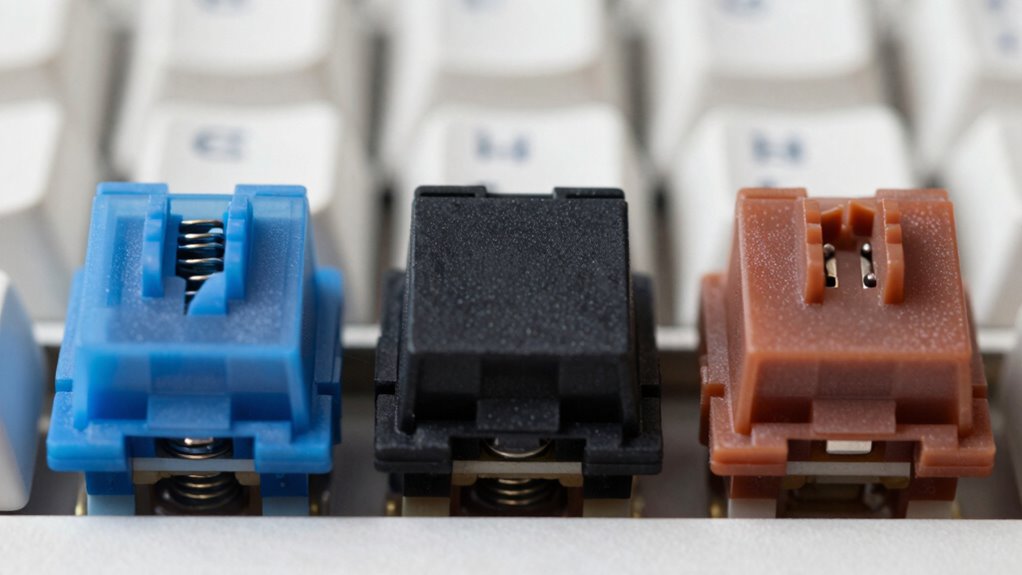
Choosing the right mechanical keyboard switch can substantially impact your typing experience, whether you’re gaming, programming, or simply browsing. The key lies in understanding the different switch actuation mechanisms, which determine how much force you need to press a key and how it feels when you do. Mechanical switches are generally classified into three main types: linear, tactile, and clicky. Linear switches provide smooth keystrokes from top to bottom without any bump, making them ideal for fast gaming where quick, repeated presses are necessary. Tactile switches, on the other hand, give you a noticeable bump mid-press, signaling that the key has registered, which many typists find satisfying and accurate. Clicky switches add an audible click to the tactile bump, offering both physical and auditory feedback, favored by those who enjoy a more pronounced response.
Choosing the right switch enhances comfort, accuracy, and satisfaction in gaming, programming, or browsing.
Understanding switch actuation mechanisms is essential when choosing a switch, as each type responds differently to key presses. For instance, linear switches activate with a consistent force along the entire key travel, which can be beneficial for rapid fire or gaming where you want minimal resistance. Tactile switches activate with a bump at a certain point, often requiring slightly more force, but providing clearer feedback that the key has registered. Clicky switches incorporate both a tactile bump and an audible click, which can be satisfying but might also be distracting in shared environments. Additionally, switch durability testing is important to ensure your keyboard withstands extensive use over time. Many switches undergo quality assurance testing to verify their performance and longevity before reaching consumers. Moreover, considering the ease of customization can allow you to modify switches or keycaps to better suit your preferences. Regular maintenance of switches can also extend their lifespan and preserve their feel over years of use.
Switch durability testing is another important factor to bear in mind. Most mechanical switches are rated for millions of keystrokes—often around 50 million—meaning they’re built to last and withstand heavy use. When evaluating switches, check their durability ratings to make sure they meet their needs. High-quality switches undergo rigorous switch durability testing to confirm that they maintain consistent actuation force and feel over time. This testing helps prevent issues like mushy keys or inconsistent responses, which can degrade your typing experience. Knowing that a switch has passed extensive durability testing gives you confidence that it will perform reliably for years.
mechanical keyboard switches
As an affiliate, we earn on qualifying purchases.
As an affiliate, we earn on qualifying purchases.
Frequently Asked Questions
Which Switch Type Is Best for Gaming?
For gaming, you’ll want a switch that offers quick response and smooth keystrokes. Linear switches are ideal because they provide consistent, fast actuation without tactile bumps, boosting your gaming performance. Look for switches with switch customization options, so you can fine-tune your setup for comfort and speed. Ultimately, the best switch for gaming depends on your personal preference, but linear switches are generally the top choice for fast-paced gameplay.
Are Mechanical Switches More Durable Than Membrane Ones?
Yes, mechanical switches are generally more durable than membrane ones. They offer longer switch longevity, often lasting for millions of keystrokes, making them ideal for heavy use. Plus, they usually require less maintenance since individual switches can be replaced if needed. In contrast, membrane keyboards tend to wear out faster and are harder to repair. So, if durability and longevity matter to you, mechanical switches are the better choice.
Can Switch Types Be Swapped on the Same Keyboard?
Switch types can often be swapped on a mechanical keyboard, but it depends on its switch compatibility. If your keyboard has hot-swappable sockets, you can easily replace switches without soldering, giving you switch replacement options. However, if your keyboard isn’t hot-swappable, switching switches requires soldering skills. Always check your keyboard’s specifications to determine switch compatibility before attempting a swap, ensuring you choose compatible switches for a smooth upgrade.
Do Different Switch Types Affect Typing Noise Levels?
Imagine you switch from blue to red switches on your keyboard; you’ll notice a difference in switch sound and typing comfort. Generally, tactile switches like blues produce louder switch sounds, while linear switches like reds are quieter. This variation affects your typing experience, especially if you work in shared spaces. Choosing the right switch type can help you minimize noise while maintaining comfortable, efficient typing.
What Are the Most Budget-Friendly Mechanical Switches?
If you’re looking for budget-friendly mechanical switches, consider options like Outemu or Gateron, which are affordable and widely available. These switches are great for switch customization and can be improved with switch lubrication, enhancing their feel and sound. Lubricating your switches reduces friction, making typing smoother and quieter. You can easily find tutorials online to help you customize and lubricate your switches, giving you a better experience without breaking the bank.
linear tactile clicky switches for keyboards
As an affiliate, we earn on qualifying purchases.
As an affiliate, we earn on qualifying purchases.
Conclusion
Choosing the right mechanical switch depends on your preferences, whether you want tactile feedback, quiet operation, or a light touch. Experimenting with different types helps you find what feels best for your typing style. Remember, “You never know until you try,” so don’t hesitate to test various switches. Ultimately, finding the perfect switch makes your keyboard experience more comfortable and enjoyable. Keep exploring, and you’ll discover what truly suits you.
custom mechanical keyboard switch replacement
As an affiliate, we earn on qualifying purchases.
As an affiliate, we earn on qualifying purchases.
high durability mechanical switches
As an affiliate, we earn on qualifying purchases.
As an affiliate, we earn on qualifying purchases.