
TL;DR

Prime made for students and young adults
- Fast, free delivery for dorm and study essentials
- Prime Video and Amazon Music included
- Member-only deals
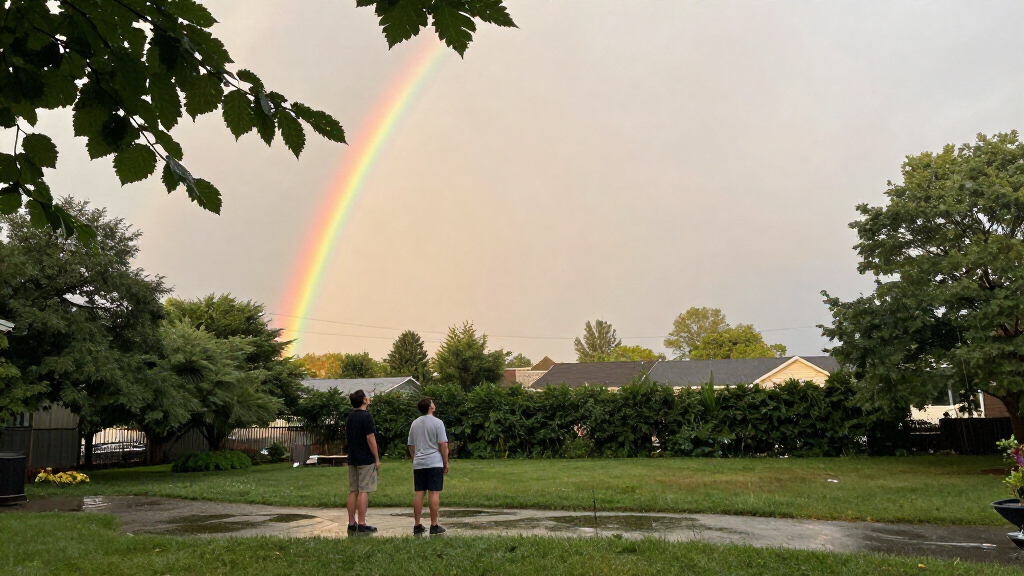
NASA’s Astronomy Picture of the Day for October 4, 2026, features a photograph of at least five supernumerary rainbows seen over New Jersey in 2018. The display followed the remnants of Hurricane Florence and illustrates how light waves interacting in similarly sized raindrops can produce extra bands beside a primary rainbow.
NASA’s Astronomy Picture of the Day for October 4, 2026, features a photograph showing at least five supernumerary rainbows over the New Jersey shore. The display appeared in 2018 after the remnants of Hurricane Florence passed through the area, and the NASA explanation describes how wave interference in raindrops can create the extra, closely spaced bands.
The image was taken by photographer John Entwistle after the storm remnants passed over the Jersey Shore. According to the APOD explanation, sunlight emerged on one side while the unusual rainbow display appeared in the opposite direction. The photographer and his daughter watched the colors fade in and out over about half an hour; at least five bands were captured in the selected photograph.
NASA says supernumerary rainbows form when falling water droplets are nearly the same size, typically less than a millimeter across. Light entering and reflecting inside the droplets behaves as a wave, and overlapping waves can reinforce or reduce one another. This interference produces additional colored bands close to the main rainbow, rather than a separate set of ordinary rainbows formed by a different weather event.
The APOD entry is an astronomy and science feature, not a report of a new storm or a newly observed phenomenon. Its credited image is by John Entwistle; the explanation lists APOD editors Robert Nemiroff, Jerry Bonnell, Cecilia Chirenti and Keighley Rockcliffe. NASA presents the historical photograph as a way to explain the optical effect and its connection to the wave behavior of light.
How Extra Rainbow Bands Form
The image makes an optical effect visible that is less commonly noticed than the familiar primary rainbow. Its multiple narrow bands show that the appearance of a rainbow depends not only on sunlight and rain, but also on the size distribution of droplets. When droplets are sufficiently similar in size, the waves of light emerging from them can interfere in a pattern that produces the extra bands.
The explanation also links a brief outdoor observation to a foundational idea in physics. NASA notes that supernumerary rainbows can be explained only by treating light as a wave, and that their recognition in the early 19th century was considered early evidence for light’s wave nature. The photograph therefore serves as both a record of a particular New Jersey sky and a visual illustration of wave interference.
Products Worth Considering

Philips Hue White and Color Ambiance Smart Light Starter Kit, 2 A19 Bulbs with Hub

Philips Hue Secure Starter Kit with Contact Sensors, Motion Sensor, Bridge, and Color Smart Bulbs

Ring Alarm Pro 8-Piece Kit with Built-In eero Wi-Fi 6 Router
As an affiliate, we earn on qualifying purchases.
A 2018 Sky After Florence
The photograph dates to 2018, after the remnants of Hurricane Florence passed over the Jersey Shore in New Jersey. The APOD account says the Sun came out in one direction and the rainbow display became visible in the opposite direction. It describes the event as a local observation after the storm’s passage, rather than attributing the rainbow itself to a special property of the hurricane.
NASA’s Astronomy Picture of the Day presents one image or photograph each day with a brief explanation written by a professional astronomer. The October 4, 2026, selection uses Entwistle’s photograph to discuss rainbows and the wave behavior of light. The date identifies when NASA featured the image; it is not the date the photograph was taken.
Limits of the Published Account
The APOD text does not provide a precise date or time for the 2018 observation, beyond placing it after the remnants of Hurricane Florence passed over the Jersey Shore. It also does not give measurements of the individual droplets or explain how their sizes were determined. The stated droplet size is a general description of the conditions under which supernumerary rainbows form, not a reported measurement from this specific scene.
The source identifies the photographer and location at the level of the Jersey Shore, New Jersey, but gives no more exact site details. It reports that at least five bands appear in the featured shot; it does not provide a separate count of every band visible during the full half-hour observation.
The Daily APOD Continues
NASA’s APOD feature is scheduled to continue with another daily image and explanation. The October 4 entry also directs readers to a birthday-image feature for APOD selections published after 1995. The supplied NASA report does not announce further research, a new observation, or a planned follow-up about the New Jersey photograph; its role is to explain the image and the optical effect it captures.
Key Questions
What are supernumerary rainbows?
They are extra, closely spaced colored bands that can appear beside a primary rainbow. NASA explains that they result from wave interference in light interacting with raindrops.
When and where was the featured photograph taken?
Photographer John Entwistle took it in 2018 over the Jersey Shore in New Jersey, after the remnants of Hurricane Florence passed through. NASA’s APOD feature appeared on October 4, 2026.
How many rainbow bands are visible in the image?
The NASA explanation says at least five supernumerary rainbows were captured in the featured photograph.
What conditions produce these extra bands?
According to NASA, the falling water droplets need to be nearly the same size, typically under one millimeter across. Light waves interacting after passing through the droplets create the additional bands.
Source: primary